
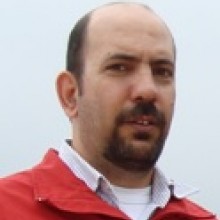
Maria Kaliva is currently a Post-doctoral Fellow in the Department of Materials Science and Technology of the University of Crete and a member of the Hybrid Nanostructures Group of the of the Institute of Electronic Structure and Laser, Foundation for Research and Technology.
Education
- 2004 PhD in Bioinorganic chemistry, Department of Chemistry, University of Crete, Greece
- 2002 MSc in Inorganic Chemistry, Department of Chemistry, University of Crete, Greece
- 2000 Bachelor in Chemistry, Department of Chemistry, University of Crete, Greece
Interests
- Design and synthesis of functional and responsive polymers of various architectures (linear, star, graft, cyclic, etc)
- Synthesis of smart biodegradable polymers
- Modification of natural polymers
- Polymers for biomedical (drug delivery and tissue engineering) applications
- Smart polymer coatings and active packaging
- Porous materials for gas capture and catalysis
Awards/Prizes/Distinctions
- 2010 Best Poster Award in Polymer Chemistry, 8th Hellenic Polymer Society Symposium
- 2007 - Best oral presentation award in the XXIII Panhellenic Conference on Solid State Physics & Materials Science
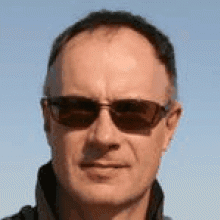
Dr George Filippidis is a Senior Staff Scientist at IESL-FORTH in charge of the non-linear microscopy (NLM) group. He received his B.Sc. degree from the Physics Department of the University of Crete in 1995 and his Doctorate degree from the Medical School of the same University in 2000. He performed his post doctoral studies at IESL-FORTH. His research group activities include the in vivo elucidation of molecular mechanisms and biological processes by employing various spectroscopic techniques with emphasis on advanced microscopic modalities, optical characterization of tissue, nanosurgery and the implementation of non-linear image contrast modalities (MPEF, SHG, PSHG, THG) as novel diagnostic tools for Cultural Heritage studies. He has published 70 articles in international peer-reviewed journals, 31 full-length articles in edited peer-reviewed volumes, 28 conference proceedings and 3 book chapters (Web of Science, h index 23). He was co supervisor in 3 PhD, 8 masters and 10 diploma theses from the Physics Department of the University of Crete and Aristotle University of Thessaloniki. He is co-author in 1 patent. He has given 3 invited talks in international conferences, a plenary talk and an invited internet lecture at Max-Born Institute.
Education
- 2000 Ph.D. in Biophysics, University of Crete
- 1995 B.Sc. in Physics, University of Crete
Career
- 11/2022 - present Senior Staff Scientist (ELE A) at I.E.S.L. - F.O.R.T.H.
- 4/2017 -10/2022 Principal Staff Scientist (ELE Β) at I.E.S.L. - F.O.R.T.H.
- 1/2007 – 3/2017 Research Scientist (permanent position) and Group Leader, Non Linear Microscopy Lab, I.E.S.L. - F.O.R.T.H.
- 1/2002 – 12/2006 Research Associate at I.E.S.L. – F.O.R.T.H.
- 3/2000-12/2001 Compulsory National Service (petty officer Greek Navy)
- 6/1996 – 3/2000 Laboratory Assistant, Biomedical Applications Group, I.E.S.L. FO.R.T.H.
Interests
- Biophotonics
- imaging
- microscopy
- spectroscopy

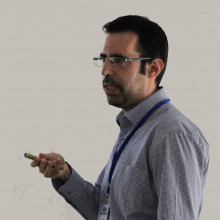
Aggelos Philippidis received his Doctorate degree from Chemistry Department, University of Crete, Greece, in 2009. His thesis was on the study of molecular compounds metal-chalcogenides: Synthesis, Characterization and study of their solution chemistry. He received his master degree from the same department, in 2003. At that period he has investigated the geographical and botanical classification of Greek extra virgin olive oil by NMR spectroscopy and chemometrics. He received his B.Sc. degree from the same department, in 2001. He is currently performing his post-doctoral studies at IESL-FORTH Crete, Greece. During his post-doctoral research he has focused on the development of a prototype Raman system for the analysis of art works and cultural heritage objects. He has long experience on the use of spectroscopic methods (Raman/SERS, FT-IR, Fluorescence spectroscopies) coupled to chemometrics tools, in relation to analysis of heritage materials and food products (wine, olive oil etc). He has published 43 articles in international refereed journals with more than 1370 citations and h-index 18 (Google Scholar). He has also 29 presentations in international conferences and he has actively participated in a number of national and international research funding projects. He has also teaching experience, as teaching personnel at Dept. of Materials Science and Engineering, Univ. of Crete, 2018-2020 and at Biomedical Engineering MSc Program, Univ. of Crete, Technical University of Crete, Foundation for Research and Technology-Hellas, 2020-2022.
Education
- 2009, PhD, Chemistry Department, Univ. of Crete, Greece
- 2003, MSc. Chemistry Department, Univ. of Crete, Greece
- 1996, BSc, Chemistry Department, Univ. of Crete, Greece
Career
- 2009-today, Post-doctoral researcher, IESL-FORTH
Interests
- Spectroscopic analytical methods in the field of culture heritage and agro-foods.
- Methodology and instrumentation Raman micro-spectroscopy.
- Surface Enhanced Raman Scattering (SERS)
- Development of portable Raman spectrometer

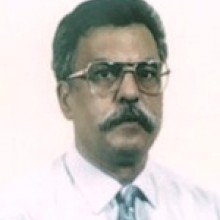
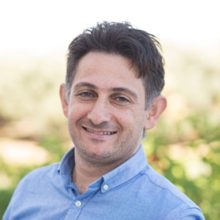
Emmanuel Stratakis is a Research Director and Acting Director of the Institute of Electronic Structure (IESL) of the Foundation for Research and Technology Hellas (FORTH). He received his Ph.D. in Physics from the University of Crete (UOC) in 2001. After graduating, he joined as a visiting Researcher the IESL-FORTH working on the ultrafast laser engineering of materials. In the fall semesters of 2006 and 2008, he was appointed as a visiting Researcher at the Department of Mechanical Engineering of the University of California, Berkeley. In 2007 he was elected Researcher at IESL-FORTH where he is leading the “Ultrafast Laser Micro- and Nano- processing” laboratory (https://www.iesl.forth.gr/en/research/ULNMP-Group; https://stratakislab.iesl.forth.gr). He has over 300 SCI publications and more than 17000 citations, h-index=71 (Google Scholar) and he has coordinated many National and European grants. He has delivered more than 150 invited and keynote lectures and has been organizer and chair in major international scientific conferences. He has been an Editor of the journals 'Optoelectronic Advances’, ‘Optoelectronic Technology’, ‘Optics and Laser Technology’ ‘Materials Today (Bio)’, and ‘International Journal of molecular Sciences’. Since 2015, he is the Director of the Nanoscience Facility of FORTH, part of the NFFA-Europe EU Infrastructure, where he is a member of the General Assembly. He is a National expert in the High-Level Group of EU on Nanotechnologies, Advanced materials, Biotechnology, Advanced Manufacturing and Processing. He is an OPTICA Fellow and Ambassador of the European Innovation Council. He is the founder and Chief Executive Officer of Biomimetic (www.biomimetic.gr).
Education
- 2001 Ph. D. in Physics, Physics Department, University of Crete, Greece.
- 1997, M. Sc in Condensed matter Physics, Physics Department, University of Crete, Greece.
- 1995, B. Sc in Physics, Physics Department, University of Crete, Greece.
Career
- 2017 - Today, Research Director, FORTH-IESL
- 2017 - Today, Adjunct Professor, Physics Department, University of Crete
- 2007 – 2017, Application Scientist, FORTH-IESL, Laser and Applications Division
- 2016, Visiting Professor (3 months), CNRS, LP3 Laboratory, Marseille, France
- 2015, Visiting Researcher (5 months), CNR, IOM, Trieste, Italy
- 2008, fall semester, Visiting Researcher, University of California, Berkeley, Department of Mechanical Engineering, California, USA
- 2003 - 2007, Adjunct Professor, Materials Science and Technology Department, University of Crete
- 2006, fall semester, Visiting Researcher, University of California, Berkeley, Department of Mechanical Engineering, California, USA
- 2003-2005, Postdoctoral Researcher, FORTH-IESL, Amorphous Materials Laboratory
Interests
- Laser-matter interaction
- Ultrashort pulsed laser processing of biomimetic surfaces
- Laser processes for organic & hybrid electronics
- Laser engineeering and diagnostics of Graphene and related 2D materials
- Advanced photonic processes in photovoltaic and energy storage devices
- Photo-assisted synthesis of nanocrystals
- Applications on non linear imaging in materials science and biology
- Laser assisted biofabrication for tissue engineering applications
- Multipurpose 3D printing complemented with subtractive manufacturing
Awards/Prizes/Distinctions
- Ranked among the top 2% of scientists worldwide
- Elected OPTICA Fellow
- EIC Ambassado
- Principal Investigator and co-Investigator in 25 European and 19 National Research Projects, (8 as Coordinator)
- Awarded a FET–OPEN grant (LiNaBioFluid) as the Coordinator
- Awarded a FET Innovation Launchpad grant (LaBioNics) as the Coordinator
- 5 Cover Pages in Advanced Functional Materials, Advanced Optical Materials, Advanced Energy Materials, Nanoscale, ChemNanoMat
- 1992, 1993, 1994, Greek National Scholarship Foundation Fellowship














Deceased
Education
- 1988, Ph.D in Solid state electornics, University of Salford, Department of Electronic & Electrical Engineering, U.K.
- 1985, M.Sc in Solid state electronics, University of Salford, Department of Electronic & Electrical Engineering, U.K.
- 1982, B.Sc in Applied physics, University of Salford, Department of Pure & Applied Physics, U.K.
Career
- 12/2016 - today, Research director, Microelectornics Research Group, FORTH - IESL, Greece
- 04/2004 - 12/2016, Senior application scientist, Microelectornics Research Group, FORTH - IESL, Greece
- 07/1998 - 04/2004, Principal application scientist, Microelectornics Research Group, FORTH - IESL, Greece
- 07/1995 - 07/1998, Associated application scientist, Microelectornics Research Group, FORTH - IESL, Greece
- 05/1990 - 07/1995, Postdoctoral fellow, Microelectornics Research Group, FORTH - IESL, Greece
- 12/1989 - 05/1990, Software developer, Eltrans international transport S.A,
- 03/1989 - 11/1989 Software developer, National defense research centre, Greece
- 02/1988 - 05/1988, Postdoctoral fellow, Microelectornics Research Group, FORTH - IESL, Greece
Interests
- High frequency & high power devices: FETs, HEMTs, PHEMTs, MO(I)SFETs (III-arsenides & III-nitrides)
- High power devices: MESFETS, JFETs, IMPATT & ZENER diodes (SiC)
- High frequency & high power MMICs (III-arsenides & III-nitrides)
- THz diodes (III-arsenides)
- III-nitrides Nanowire and FINFET transistors
- Magnonics
- 2D materials based transistors, CNT based devices
- GaN based Qubits
- III-nitrides based UV detectors
- III-arsenides & III-nitrides photovoltaics
- III-nitrides SAW & FBAR based sensors
- III-nitrides CHEMFET based chemical sensors
- III-nitrides LAMB based biosensors
- Arrays of polymeric microneedles based EEG sensors
- Piezoelelectric sensors for gait monitoring
- RF MEMS Piezoelectric (III-nitrides) cantilevers
- Thermoelectric materials and devices
- Left handed & photonic structures
- Reconfigurable front end transmission/reception modules
- 3D system in chip (SiP) solutions for high power miniaturized modules
Awards/Prizes/Distinctions
- 2018, Elected as Vice President of the Greek Micro and Nano Society
- 2016, Re-elected to the Scientific Council of IESL (1st in preference)
- 2013, Elected to the Scientific Council of IESL
- 2007, Re-elected Vice President of the Greek Micro and Nano Society
- 2005, Key member of the research team of FORTH (project FP6 “DALHM”) that won one of the EU Descartes prizes
- 2004, Elected as Vice President of the Greek Micro and Nano Society
- 2003, Elected to the Board of Directors of the European Microwave Association (EuMA) for 3 years
- 2003, Prize "Tudor Tanasescu" of the Romanian Academy of Sciences for my work in the membrane supported active & passive devices
- 2002, MRG Leader in the project FP4 INCO-COPERNICUS project "MEMSWAVE" (co- ordinated by IMT Bucharest), that was among the 10 finalists for the EU Descartes prize.