

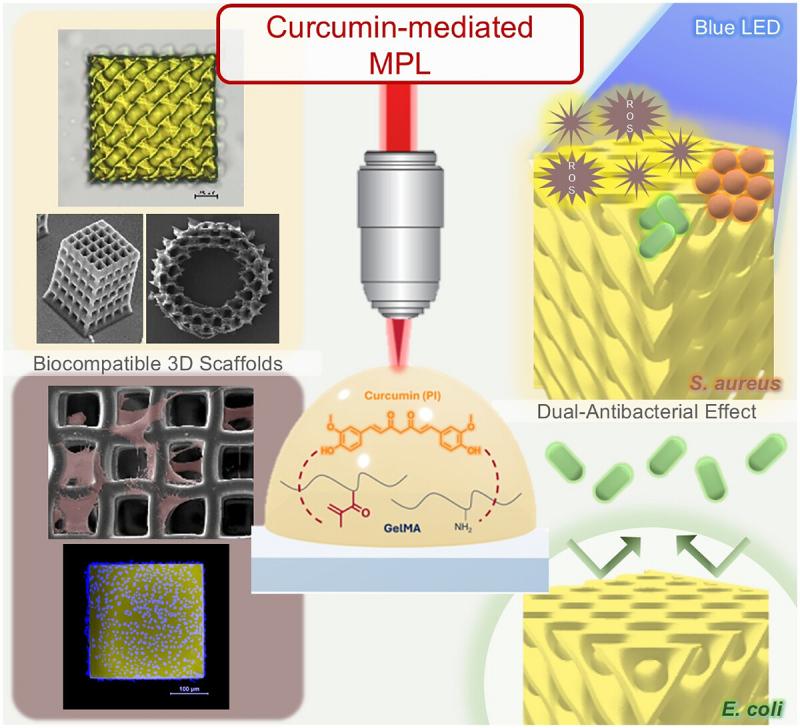
Can a natural bioactive molecule become an integral part of the 3D microfabrication process itself?
In this work, published in the journal Advanced Functional Materials, we demonstrate a one-step multiphoton lithography strategy in which curcumin serves not only as a photosensitizer for the fabrication of high-resolution GelMA 3D scaffolds, but also as a bioactive component that endows the resulting structures with advanced functional properties.
The resulting microarchitectures combine precise 3D structuring and cell compatibility with the intrinsic antibacterial and antifouling properties of curcumin.
This approach enables bioactivity to be incorporated directly during the fabrication process, opening new possibilities for advanced biomaterials and tissue engineering applications.
The work was carried out at the Institute of Electronic Structure and Laser (IESL), Foundation for Research and Technology-Hellas (FORTH), by the TERMIm Lab, led by Dr. Anthi Ranella and the NLL Group, led by Dr. Maria Farsari, in collaboration with the group of Prof. Anna Mitraki at the Department of Materials Science and Engineering, University of Crete. Anna Mitraki is also a collaborating faculty member of IESL. The first author is PhD candidate Myrto Charitaki.
Reference: Charitaki, M., Stavrou, M., Apostolidou, C. P., Kabouraki, E., Gray, D., Mitraki, A., ... & Farsari, M. (2026). One‐Step Curcumin‐Mediated Multiphoton Lithography for Bioactive 3D Scaffolds. Advanced Functional Materials, e77532. doi: https://doi.org/10.1002/adfm.77532
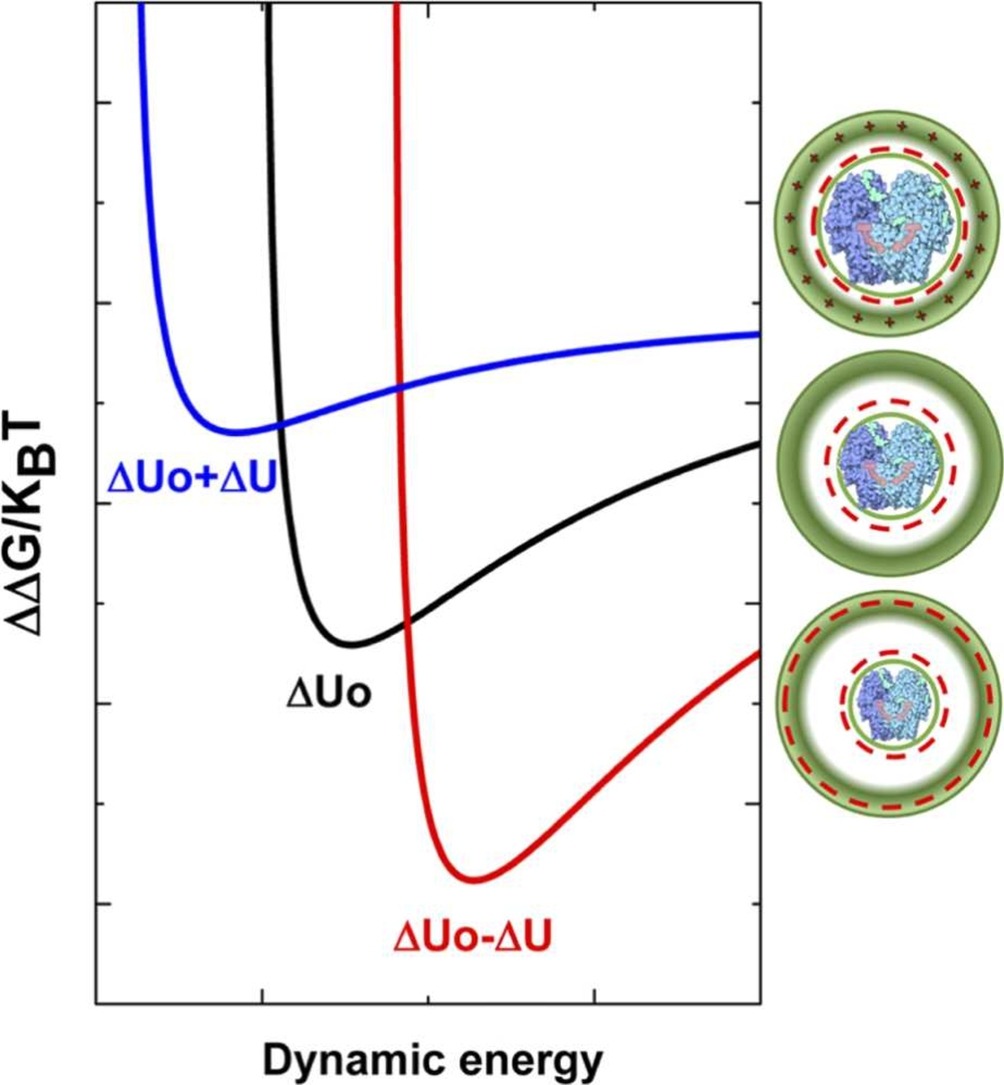
We are proud to announce the publication of a new research study by M. Androulidaki from the IESL–FORTH MRG team, in collaboration with Professor Nikos Chaniotakis from the Department of Chemistry, University of Crete. The study, entitled “Nanocage-mediated enzyme stabilization: The effect of size and charge”, has been published in the prestigious journal Sensors and Actuators B: Chemical.
Abstract
Enzymes are tools utilised in many scientific disciplines. The specific protein employed for each application depends on its specific activity, as well as its physical characteristics, and specifically its operation stability over time. These properties depend not only on the enzyme itself, and on the surrounding environment. The outer boundary, being solvation, cellular crowding, immobilization, or synthetic encapsulation modulates both stability and accessibility by imposing confinement and regulating molecular diffusion. Thus, enzyme stabilization and functional accessibility across disciplines is less about modifying the protein alone, but also on the precise engineering of the spatial and physicochemical properties of its environment. Here, we expand on the theoretical aspect regarding the effect of the protein stabilization effect within solid nanostructures, and its possible effect on the biosensor performance. This work focusses on the effect of not only the size of the nanocavity, but also on the type of solvent utilized, which in turn determines the surface charge. This information is vital in designing the appropriate nanocavity to be used for the immobilization and stabilization of proteins for use in biotechnology applications, such as biosensors. It is shown that the inclusion in a nanocage and the potential difference between the cavity walls and the protein surface determines the energy of the system, thus altering the observed stabilization effect. Based on these results, the charge type and density of the cage must be controlled for optimum protein stabilization, which will result the improvement of a biosensor performance, especially regarding its signal stability and lifetime.
Reference: Chaniotakis, N., & Androulidaki, M. (2026). Nanocage-Mediated Enzyme Stabilization: The Effect of Size and Charge. Sensors and Actuators B: Chemical, 140690. Doi: https://doi.org/10.1016/j.snb.2026.140690
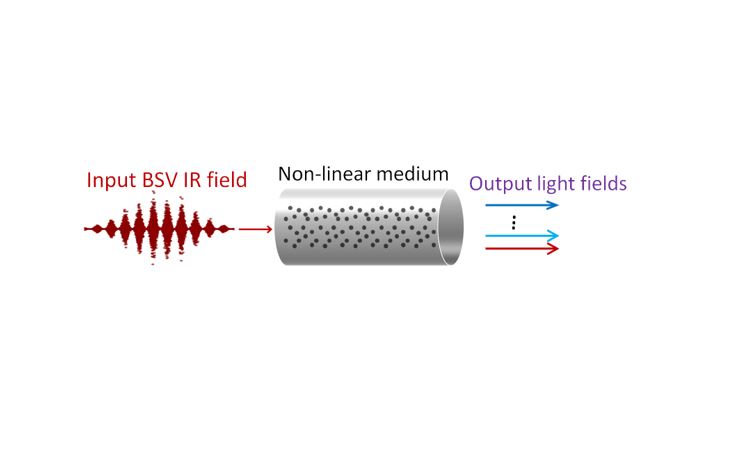
In a study published in Nature Communications (2026), a team of researchers from ICFO (Barcelona, Spain), TU Wien (Vienna, Austria), UCL (London, UK), MBI (Berlin, Germany), and IESL-FORTH (Heraklion, Greece) presented a solution to an important emerging open problem: understanding how bright squeezed vacuum (BSV) light propagates through nonlinear media, undergoing high-harmonic generation and how this propagation influences both the generated nonlinear signals and the quantum properties of the radiation. The work, led by Paraskevas Tzallas, establishes a fully quantized theoretical framework for investigating BSV-driven nonlinear optical processes, providing a foundation for future research in nonlinear optics, strong-field quantum optics, and ultrafast science across all states of matter.
Reference:
[1] J. Rivera-Dean, D. Kanti, P. Stammer, S. Carlström, N. Tsatrafyllis, M. Yu Ivanov, M. Lewenstein, and P. Tzallas, Nature Commun., (2026). (https://www.nature.com/articles/s41467-026-75173-8).
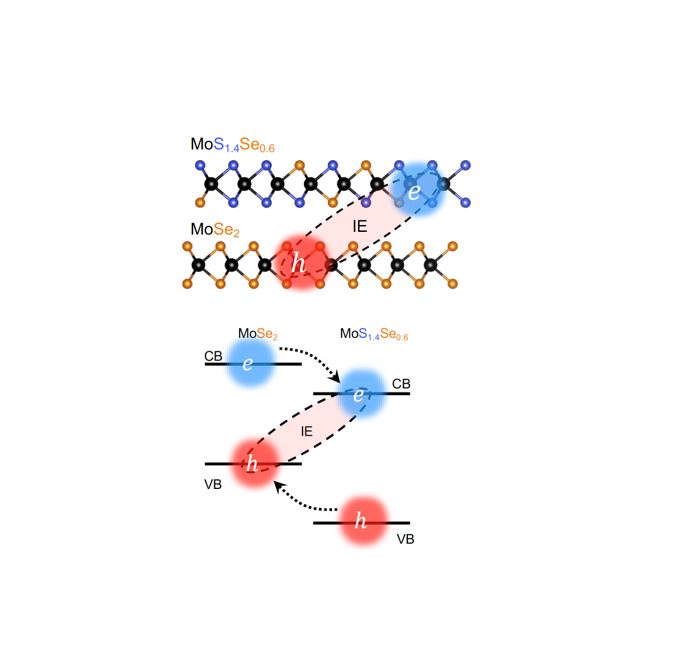
A new study by researchers at IESL-FORTH and the University of Crete, in collaboration with colleagues from the National Institute for Materials Science (NIMS), Japan, demonstrates the formation of dipolar interlayer excitons in heterobilayers composed of transition metal dichalcogenide alloys. By combining alloy engineering with van der Waals heterostructures, the team observed long-lived interlayer excitons exhibiting excitation-power-dependent energy shifts, revealing strong dipolar interactions between excitons. These findings establish alloyed two-dimensional semiconductors as a promising platform for tailoring excitonic properties and exploring next-generation excitonic and quantum optoelectronic devices.
Reference: Katsipoulaki, E., Chatzarakis, N. G., Rigoutsou, E., Katrisioti, D., Taniguchi, T., Watanabe, K., ... & Paradisanos, I. (2026). Dipolar interlayer excitons in transition metal dichalcogenide alloy heterobilayers. Journal of Physics: Materials. Doi: 10.1088/2515-7639/ae9192
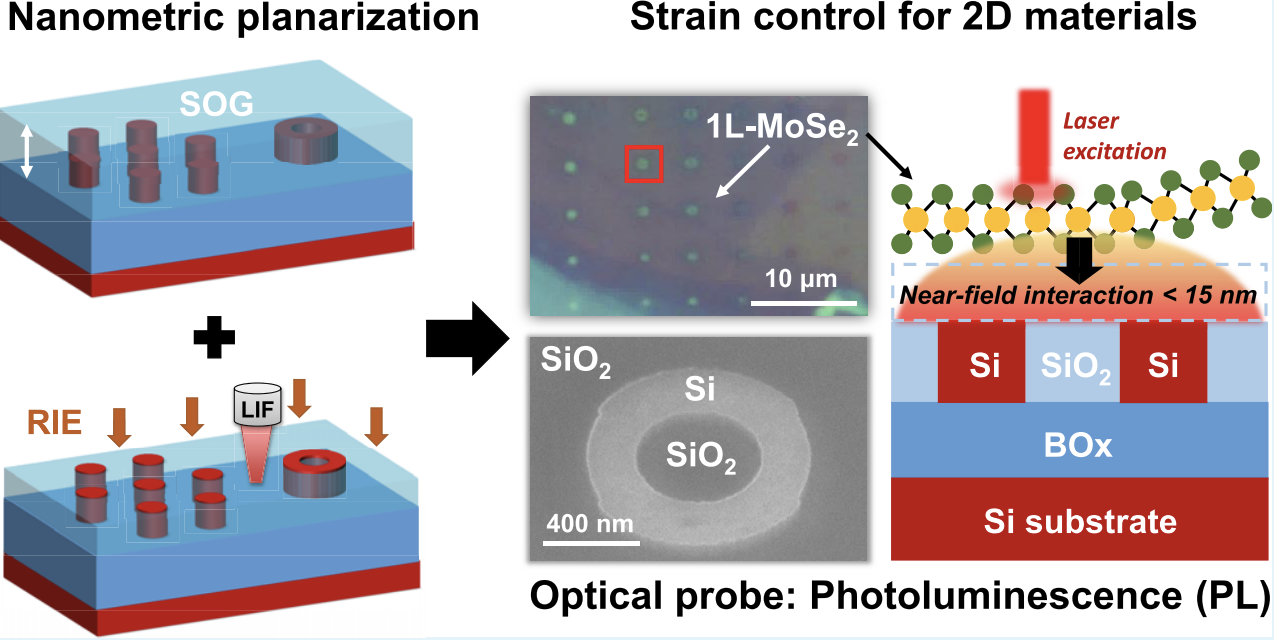
Researchers from IESL-FORTH, Danae Katrisioti and Ioannis Paradisanos (affiliations: IESL-FORTH and MSE - UOC), together with collaborators from LAAS-CNRS have developed a versatile planarization strategy that allows atomically thin materials to be integrated with silicon nanoantennas while preserving strong optical near-field enhancement.
The approach is largely independent of antenna geometry and overcomes one of the key challenges in nano-optics: bringing two-dimensional materials within nanometers of optical hotspots without introducing significant strain or surface irregularities. The work paves the way for scalable hybrid nanophotonic platforms with applications in enhanced light–matter interactions, spectroscopy, and future optoelectronic devices.
Reference: Jonas Müller, Danae Katrisioti, Peter R. Wiecha, Nicolas Mallet, Anna E. Holz, Sylvain Pelloquin, Aurélie Lecestre, Jean-Marie Poumirol, Ioannis Paradisanos, Guilhem Larrieu; Geometry-Independent Nanometric Planarization of 3D Nanostructures for Strain-Controlled Integration of 2D Materials. ACS Appl. Mater. Interfaces 5 August 2026; 18 (30): 42011–42019. https://doi.org/10.1021/acsami.6c07634
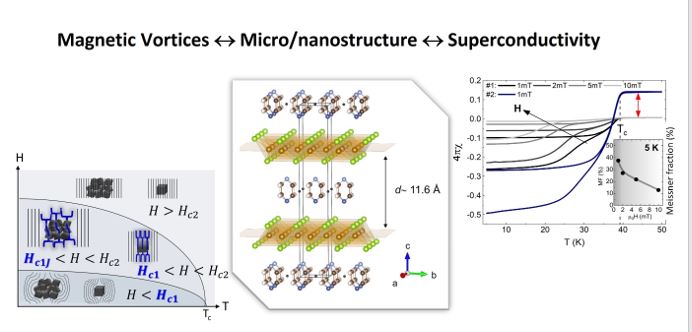
Collaborative research by FORTH’s QMM Lab reveals that organic-molecule-intercalated iron superconductors — despite reaching a high Tc of 39 K — struggle to carry high current.
Superconductors carry electricity with zero resistance and underpin technologies from MRI scanners to fusion reactors. Yet what determines their real-world usefulness isn't only how cold they must be — it's how much current they can sustain, known as the critical current density (Jc).
In a new study published in Superconductor Science and Technology, Myrsini Kaitatzi and Alexandros Lappas (IESL-FORTH & University of Crete) probe this trade-off in an iron selenide (FeSe) superconductor whose transition temperature (Tc) is raised from 8 K to nearly 39 K by intercalating lithium and pyridine molecules between its atomically thin 2D layers. This structural modification expands the interlayer spacing and enhances superconductivity — but the soft-chemistry synthesis route required to achieve it also yields a polycrystalline material with an inherently complex micro/nanostructure.
Using contact-free trapped-flux magnetization measurements, the team compared a single-phase powder with a densified pellet. Both showed Jc values (~103 A cm-2) roughly an order of magnitude below single-crystal FeSe, driven primarily by weak intergranular coupling that lets magnetic vortices penetrate too readily across grain boundaries. Residual impurity phases further degraded performance in the pellet, despite improved grain-to-grain contact upon pelletization.
The results sharpen a broader materials-science challenge: unlocking the high transition temperatures offered by molecular intercalation demands equal attention to disorder and microstructural control — grain connectivity, phase purity, and densification — if these quantum materials are to progress from laboratory curiosities toward viable high-field superconducting wires.
Citation: M. Kaitatzi & A. Lappas, Supercond. Sci. Technol. 39 065014 (2026).
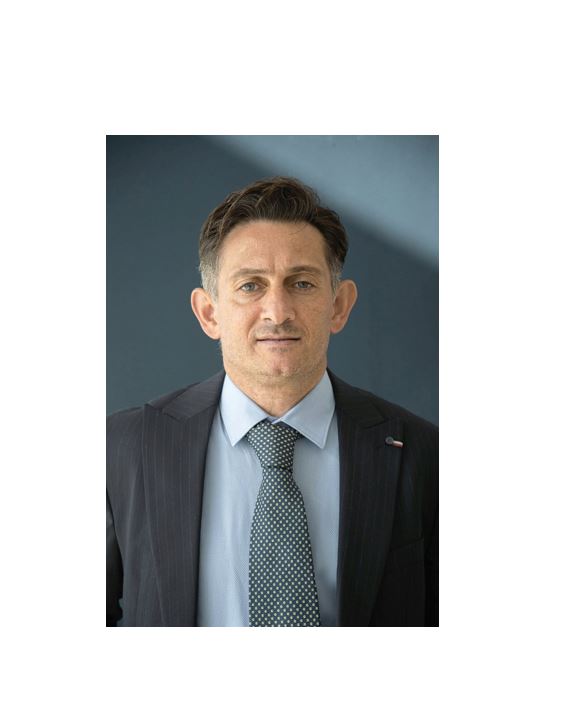
The Institute of Electronic Structure and Laser (IESL) of the Foundation for Research and Technology – Hellas (FORTH) announces the election of Dr. Emmanuel Stratakis as its new Director, marking the beginning of a new era of scientific excellence, innovation, and international collaboration for one of Europe's leading research institutes.
The election process was concluded following the meeting of the Special Evaluation Committee on 25 June 2026. Prior to the Committee's deliberations, IESL personnel—including researchers, collaborating faculty members, scientific, technical, administrative, and support staff—were invited to express their views on the candidates through FORTH's established digital consultation platform. This institutional consultation forms an important part of the selection process, providing the Committee with valuable insight into the candidates' leadership qualities, vision, and ability to guide the Institute's future development.
A globally recognized scientist in the fields of ultrafast lasers, laser–matter interaction, and nanophotonics, Dr. Stratakis has devoted more than two decades to pioneering research at IESL-FORTH, significantly contributing to the Institute's international reputation as one of Europe's premier research centres.
Dr. Stratakis received his Ph.D. in Physics from the University of Crete in 2001. Following his doctoral studies, he joined IESL-FORTH as a Visiting Researcher, focusing on ultrafast laser engineering of materials. He also served as a Visiting Researcher at the University of California, Berkeley, Department of Mechanical Engineering, during the fall semesters of 2006 and 2008. In 2007, he was elected Researcher at IESL-FORTH, where he established and continues to lead the internationally recognized Ultrafast Laser Micro- and Nano-processing Laboratory.
Reflecting his long-standing commitment to the Institute's leadership and strategic development, Dr. Stratakis served as Vice Director of IESL from April 2023 to April 2025. In May 2025, he was appointed Acting Director of IESL, a position he held until his election as Director, ensuring continuity in the Institute's scientific and administrative leadership.
His scientific achievements include more than 300 publications in peer-reviewed journals, over 17,000 citations, and an h-index of 71 (Google Scholar). Throughout his career, he has coordinated numerous national and European research projects, delivered more than 150 invited and keynote lectures, and served as organizer and chair of major international scientific conferences.
Dr. Stratakis has served on the editorial boards in several leading international journals, including Optoelectronic Advances, Optoelectronic Technology, Optics and Laser Technology, Materials Today Bio, and the International Journal of Molecular Sciences. Since 2015, he has served as Director of the FORTH Nanoscience Facility, a key node of the NFFA-Europe European Research Infrastructure, while also participating in its General Assembly. In addition, he serves as a National Expert in the European Union High-Level Group on Nanotechnologies, Advanced Materials, Biotechnology, Advanced Manufacturing and Processing, is an OPTICA Fellow, a European Innovation Council Ambassador, and Founder and Chief Executive Officer of Biomimetic. His contributions have been recognized with numerous international awards - distinctions, and he is consistently ranked among the top 2% of scientists worldwide.
Dr. Stratakis' election reflects both his outstanding scientific achievements and his long-standing commitment to IESL and FORTH. Under his leadership, the Institute is expected to further strengthen its position as a global centre of excellence, advancing frontier research, fostering innovation, expanding international partnerships, and translating scientific discoveries into societal and technological impact.
The entire IESL-FORTH community extends its warmest congratulations to Dr. Emmanuel Stratakis and wishes him every success in his new role as Director of IESL.

Σημαντική επιτυχία για την ελληνική και ευρωπαϊκή ερευνητική κοινότητα αποτελεί η ένταξη της πρότασης NANO Foundries and Fine Analysis – 2050 (NFFA2050) στον Οδικό Χάρτη ESFRI 2026, όπως ανακοινώθηκε από τον Πρόεδρο του ESFRI στις 25 Ιουνίου 2026.
Το Ίδρυμα Τεχνολογίας και Έρευνας (ΙΤΕ), μέσω του Ινστιτούτου Ηλεκτρονικής Δομής και Λέιζερ (ΙΗΔΛ), συμμετείχε ως ένας από τους τρεις βασικούς αιτούντες και ένα από τα οκτώ ιδρύματα που υπέγραψαν το σχετικό Μνημόνιο Συνεργασίας, επιβεβαιώνοντας τον πρωταγωνιστικό του ρόλο στη διαμόρφωση της νέας ευρωπαϊκής ερευνητικής υποδομής.
Το NFFA2050 αποτελεί τη φυσική εξέλιξη της επιτυχημένης 11ετούς λειτουργίας του NFFA-Europe, μέσω του οποίου περισσότεροι από 3.000 ερευνητές απέκτησαν πρόσβαση σε περισσότερες από 180 ερευνητικές μεθόδους και 600 εξειδικευμένα επιστημονικά όργανα. Η νέα υποδομή θα προσφέρει ένα ολοκληρωμένο ευρωπαϊκό περιβάλλον για την έρευνα στην κβαντική ύλη, στα προηγμένα ενεργειακά υλικά και στα βιοϋλικά, συνδυάζοντας δυνατότητες από μεγάλες ερευνητικές εγκαταστάσεις με προηγμένα ακαδημαϊκά όργανα για πολυτεχνικές πειραματικές προσεγγίσεις και θεωρητική έρευνα.
Βασικός στόχος του NFFA2050 είναι η δημιουργία ενός νέου, ψηφιακά ενισχυμένου ερευνητικού οικοσυστήματος, όπου οι χρήστες θα έχουν πρόσβαση σε ολοκληρωμένες και βελτιστοποιημένες ροές εργασίας, προσαρμοσμένες στις ανάγκες της έρευνάς τους. Για τον σκοπό αυτό, η υποδομή θα ενσωματώνει υπηρεσίες βελτιστοποίησης πρόσβασης βασισμένες στην Τεχνητή Νοημοσύνη, Ψηφιακά Δίδυμα (Digital Twins), δεδομένα σχεδιασμένα σύμφωνα με τις αρχές FAIR (FAIR-by-design) και προηγμένες δυνατότητες ανάλυσης σε πραγματικό χρόνο.
Παράλληλα, η υποδομή θα υποστηρίζει τόσο τη βασική έρευνα όσο και έργα καινοτομίας, δημιουργώντας ένα προηγμένο ερευνητικό περιβάλλον για την ανάπτυξη και αξιολόγηση τεχνολογιών βαθιάς τεχνολογίας (deep-tech), τη συνδημιουργία πρωτοτύπων με βιομηχανικό προσανατολισμό και τη διασύνδεση με τις Τεχνολογικές Υποδομές σε ενδιάμεσα επίπεδα τεχνολογικής ωριμότητας (TRLs).
Η ένταξη του NFFA2050 στον Οδικό Χάρτη ESFRI αποτελεί καθοριστικό βήμα για την υλοποίηση της υποδομής, καθώς θέτει τις βάσεις για την οργάνωση και τη λειτουργία της σε ευρωπαϊκό επίπεδο, την εξασφάλιση των απαιτούμενων πόρων και την ανάπτυξη συνεργειών με το ευρωπαϊκό οικοσύστημα ερευνητικών υποδομών στον τομέα των Φυσικών Επιστημών και Μηχανικής, καθώς και σε συναφείς επιστημονικούς και τεχνολογικούς τομείς.
Η επιτυχία αυτή ακολουθεί την έγκριση μιας ακόμη ερευνητικής υποδομής ESFRI υπό τον συντονισμό του ΙΗΔΛ, της E-RIHS, η οποία λειτουργεί πλέον υπό τη μορφή ERIC, ενισχύοντας περαιτέρω τον ρόλο του ΙΤΕ ως ενός από τους σημαντικότερους ελληνικούς και ευρωπαϊκούς φορείς στον σχεδιασμό, την ανάπτυξη και τη λειτουργία ερευνητικών υποδομών διεθνούς εμβέλειας.
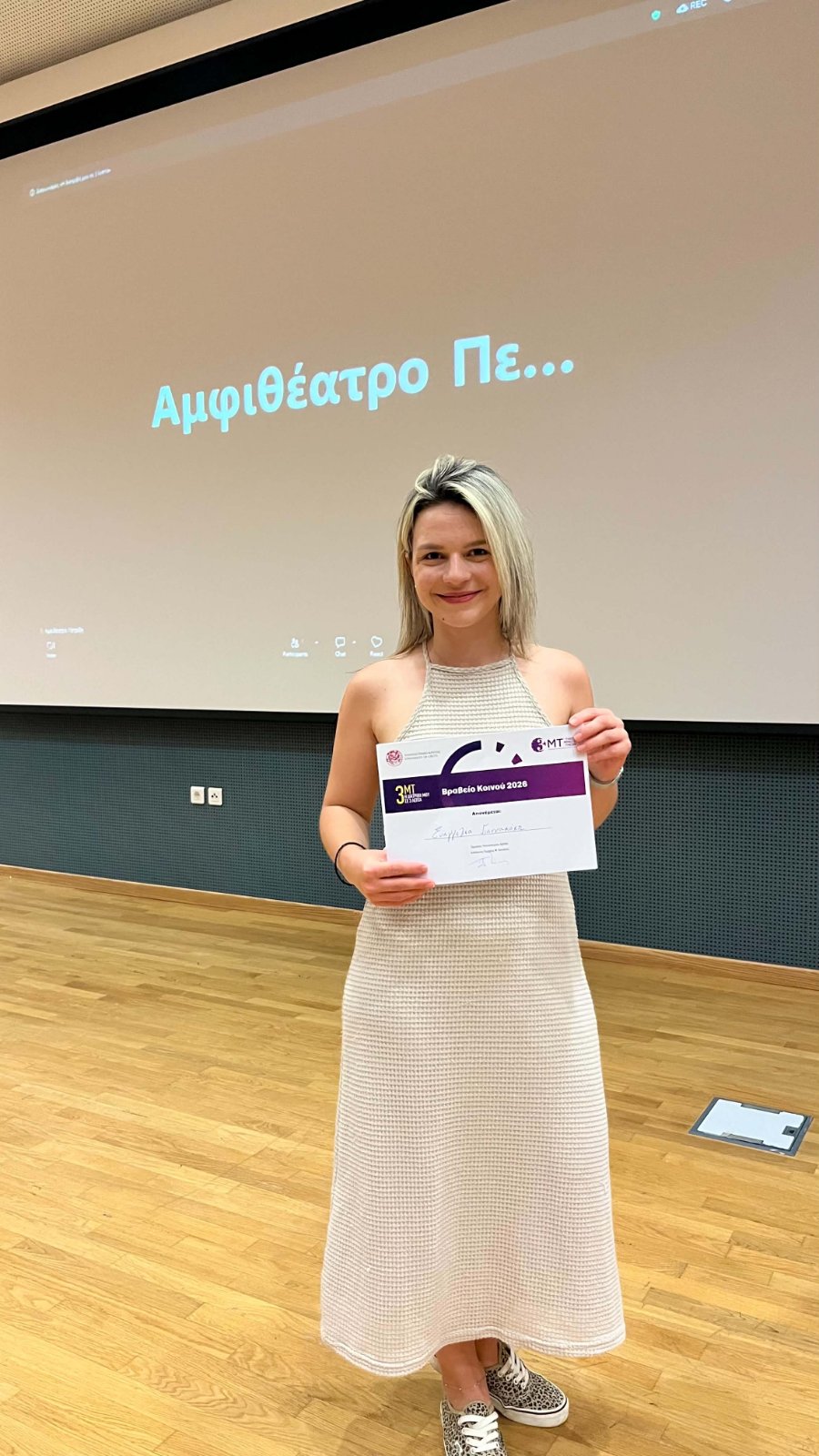
Το Ινστιτούτο Ηλεκτρονικής Δομής και Λέιζερ (ΙΗΔΛ) του ΙΤΕ εκφράζει τα θερμά του συγχαρητήρια στην Υποψήφια Διδάκτορα του Τμήματος Χημείας του Πανεπιστημίου Κρήτης, Ευαγγελία Γιαννακάκη, για την εξαιρετική της διάκριση στον διαγωνισμό «Η Διατριβή μου σε 3 λεπτά», όπου απέσπασε το Βραβείο Κοινού. Η διάκριση αυτή αποκτά ιδιαίτερη αξία καθώς προέκυψε ύστερα από μια απαιτητική διαγωνιστική διαδικασία δύο φάσεων, στην οποία συμμετείχαν υποψήφιοι διδάκτορες από διαφορετικά επιστημονικά πεδία. Στην πρώτη φάση επιλέχθηκαν οι δέκα καλύτερες υποψηφιότητες, ενώ στη δεύτερη και τελική φάση, που πραγματοποιήθηκε στις 10 Ιουνίου, απονεμήθηκαν συνολικά τρία βραβεία: δύο από την κριτική επιτροπή και ένα από το κοινό, το οποίο κατέκτησε η Ευαγγελία Γιαννακάκη.
Η Ευαγγελία εκπονεί τη διδακτορική της διατριβή στην Ομάδα Λειτουργικών Πολυμερικών Νανοδομών (Functional Polymer Nanostructures) του ΙΗΔΛ, με αντικείμενο την ανάπτυξη αυτοϊάσιμων πολυμερικών υλικών, τα οποία έχουν τη δυνατότητα να αποκαθιστούν μικρές φθορές μέσω της εφαρμογής θερμότητας. Η έρευνά της στοχεύει στη δημιουργία καινοτόμων υλικών που μπορούν να συμβάλουν στη μείωση του κόστους συντήρησης, των αποβλήτων και της σπατάλης πόρων, ενισχύοντας τη βιωσιμότητα και την κυκλική οικονομία , ενώ παράλληλα συμβάλλει στην παραγωγή νέας γνώσης και στην προώθηση της επιστημονικής αριστείας.
Η διάκρισή της αποτελεί αναγνώριση της ποιότητας του ερευνητικού της έργου, αλλά και της αφοσίωσης, της δημιουργικότητας και της επιστημονικής της κατάρτισης. Παράλληλα, αναδεικνύει το υψηλού επιπέδου ερευνητικό και εκπαιδευτικό περιβάλλον που προσφέρει το ΙΗΔΛ, το οποίο επενδύει συστηματικά στην εκπαίδευση και την εξέλιξη νέων επιστημόνων, παρέχοντάς τους τα εφόδια για να διακρίνονται τόσο στην έρευνα όσο και στην επικοινωνία της επιστήμης προς την κοινωνία. Η επιτυχία της αποτελεί ιδιαίτερη τιμή για το Ινστιτούτο, καθώς επιβεβαιώνει την ποιότητα της έρευνας που διεξάγεται στο ΙΗΔΛ και υπογραμμίζει τη σημασία της σύνδεσης της επιστημονικής γνώσης με το ευρύτερο κοινό. Ως νέα ερευνήτρια, η Ευαγγελία αποτελεί ένα ιδιαίτερα θετικό πρότυπο για τη νέα γενιά επιστημόνων, ενώ η διάκρισή της αναδεικνύει και τη σημαντική συμβολή των γυναικών στην έρευνα, την καινοτομία και την επιστημονική πρόοδο.
Αναφερόμενη στην ερευνητική της πορεία, η Ευαγγελία σημείωσε ότι η ποιότητα της ερευνητικής ομάδας και του επιστημονικού περιβάλλοντος αποτέλεσαν καθοριστικούς λόγους για να συνεχίσει την ερευνητική της δραστηριότητα στην Ελλάδα, αναδεικνύοντας τη σημασία των ισχυρών ερευνητικών υποδομών και της επιστημονικής καθοδήγησης που προσφέρει το ΙΗΔΛ.
Θερμά συγχαρητήρια στην Ευαγγελία για την επιτυχία της. Της ευχόμαστε ολόψυχα καλή συνέχεια στην ακαδημαϊκή και ερευνητική της πορεία, με ακόμη περισσότερες επιτυχίες και διακρίσεις στο μέλλον, καθώς και κάθε επιτυχία στην προσπάθειά της να μετατρέψει τα ερευνητικά της αποτελέσματα σε εφαρμογές με ουσιαστικό κοινωνικό και περιβαλλοντικό αντίκτυπο.
Η επιτυχία νέων ερευνητριών όπως η Ευαγγελία Γιαννακάκη αποτελεί έμπρακτη απόδειξη ότι η επένδυση στη νέα γενιά επιστημόνων και η ενίσχυση της συμμετοχής των γυναικών στην έρευνα αποδίδουν καρπούς και συμβάλλουν ουσιαστικά στη διαμόρφωση του μέλλοντος της επιστήμης και της καινοτομίας.
Οι τρεις βραβευθείσες ερευνήτριες προσκλήθηκαν την επόμενη ημέρα στην εκπομπή της κας Αντιγόνης Ανδρεαδάκη στον ραδιοφωνικό σταθμό CRETAONE, όπου μίλησαν για την έρευνά τους, την εμπειρία τους από τον διαγωνισμό και τη σημασία της επικοινωνίας της επιστήμης προς το ευρύ κοινό.
Διαβάστε τη συνέντευξη στο CRETAONE: Οι νέες ερευνήτριες του Πανεπιστημίου Κρήτης που ξεχώρισαν στη «Διατριβή σε 3 Λεπτά»
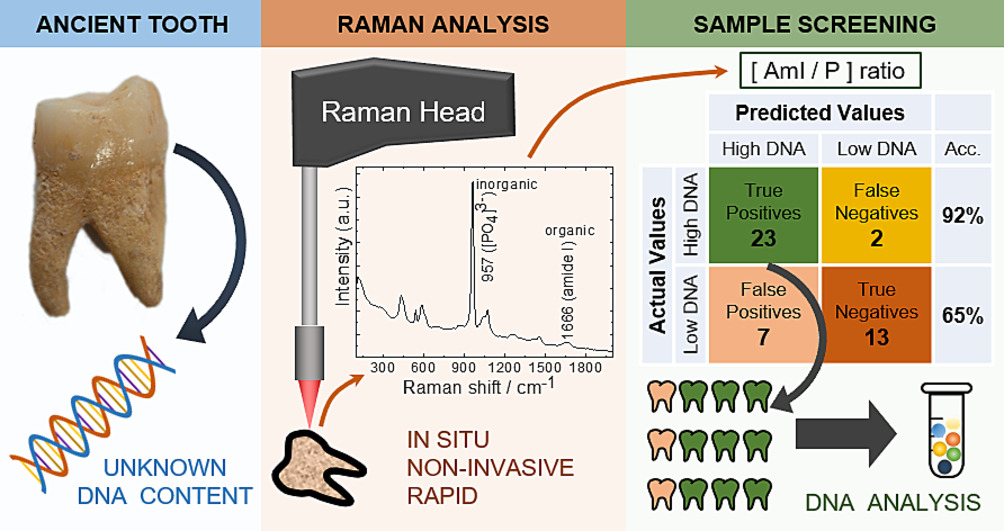
Supported through a Theodore Papazoglou FORTH Synergy Grant (Spectra-Gen: Spectroscopic Screening of Ancient Dental Remains for Optimized Archaeogenetic Analysis), researchers from IESL-Photonics for Heritage Science group, IMBB- Ancient DNA Lab, and ICS, studied a large number of ancient teeth, originating from various excavations and contexts in Greece and across a time span of 8 millennia.
In the context of this study, published recently in the Microchemical Journal, doi: org/10.1016/j.microc.2026.117446, a straightforward and fast spectrochemical methodology, based on micro-Raman spectrometry, was developed and shown to serve as a suitable tool for screening teeth prior to genetic analysis, predicting which ones might exhibit a higher human DNA preservation.
As detailed in the article by A Philippidis et al, screening is achieved on the basis of a simple molecular index, the amide-to-phosphate ratio (Am-I/P), extracted from key vibrational bands in the Raman spectra, which serves as a proxy of the dental tissue protein content (typically collagen) relative to hydroxyapatite, namely the inorganic matrix. Analysis is performed, non-invasively, directly on intact teeth, by use of a compact, mobile micro-Raman spectrometer, focusing the laser probe on the cementum part, known to be protein rich. Ancient DNA analysis showed that teeth found to preserve endogenous human DNA, to a reasonable degree, showed indeed a good statistical correlation with the ones identified to be protein-rich based on the Am-I/P.
