
Position Description
The Institute of Electronic Structure and Laser of the Foundation for research and Technology Hellas (IESL -FORTH), in the framework of the project PHOTOENERGY is seeking to recruit one lab technician Position Description.
The technician is expected to join the lab for technical support.
Required Qualifications
- Bachelor degree (B. Sc) in Physics
- MS.c. degree in Physics
- Very good knowledge of COMSOL Multiphysics software
- Very good knowledge of English language
Desirable Qualifications
Publications related to ultrafast transient absorption spectroscopy
Application Procedure
Interested candidates who meet the aforementioned requirements are kindly asked to submit their applications to the address (hr@iesl.forth.gr), with cc to the Scientific Responsible, Dr P. Loukakos (loukakos@iesl.forth.gr).
In order to be considered, the application must include:
- Application Form (Form Greek or Form English to the left)
- Detailed curriculum vitae (CV) of the candidate
- Scanned Copies of academic titles
Appointment Duration
6Position Description
The PhD student will work on the design, analysis and electromagnetic characterization of THz metamaterials and metasurfaces, with emphasis on reconfigurable THz metamaterials, including time modulated media.
For the full announcement, follow the link "Related Documents"
Required Qualifications
- Bachelor in Electrical Engineering
- Master in Electrical Engineering
- Experience in the study of metamaterials
Desirable Qualifications
- Good knowledge of English
- Knowledge of a Maxwell equation's solver, like COMSOL or CST
Application Procedure
Interested candidates who meet the aforementioned requirements are kindly asked to submit their applications to the address (hr@iesl.forth.gr), with cc to Prof. Maria Kafesaki (kafesaki@iesl.forth.gr).
In order to be considered, the application must include:
- Application Form (Form Greek or Form English to the left)
- Detailed curriculum vitae (CV) of the candidate
- Scanned Copies of academic titles
- Certificate of enrollment in a PhD program
Appointment Duration
12 monthsPosition Description
Structure and electrical properties of silicon nitride and high-k dielectrics
For the full announcement, follow the link "Related Documents"
Related Project
AGAMI_EURIGAMI -Required Qualifications
- Bachelor's degree in Physics.
- Demonstrated expertise in quantitative analysis of structural properties of solids - minimum 3 years.
- Experience in electrical characterization of ceramics within versatile sample environments, including cryogenic temperatures - minimum 3 years.
Application Procedure
Interested candidates who meet the aforementioned requirements are kindly asked to submit their applications to the address (hr@iesl.forth.gr), with cc to Dr George Konstantinidis (aek@physics.uoc.gr) and to Dr Alexandros Lappas (lappas@iesl.forth.gr) .
In order to be considered, the application must include:
- Application Form (Form Greek or Form English to the left)
- Detailed curriculum vitae (CV) of the candidate
- Scanned Copies of academic titles
- Certificate for enrollment in PhD program
Appointment Duration
12 monthsFunding



To: 04/11/2024 14:00
SLB is a leading oilfield services company that has provided sub-surface measurement, well-construction and production services to the oil and gas industry worldwide for the last 100 years. A major part of well-construction is drilling the well which, despite being a 100yr old industry, is a process that still experiences significant technical challenges. These industry challenges continue to be highly relevant as slb extends its, already significant, activity in adjacent energy transition technologies that also require deep drilling, that is geothermal, carbon capture & sequestration and sustainable lithium production.
Here I introduce the company, drilling fluids and the essential parts of a well-construction process. I focus on the ability of drilling fluids to carry rock cuttings to the surface. Within the industry this particle-carriage problem is, in general, modelled using a generalized Newtonian fluid. Yet there are repeated industry reports comparing fluids where the flow curves are closely similar but where cuttings transport is demonstrably different. To probe this, we combine a Xanthan solution as a proxy for a water-based drilling fluid together with an aqueous Bentonite dispersion that at low concentrations in the Xanthan solution is representative of shale contamination of a water-based drilling fluid. The aqueous Bentonite solution alone has rheological properties similar to those of an oil-based drilling fluid. The concentrations of each of the two fluids, Xanthan and Bentonite, are chosen so that their generalized Newtonian properties are closely similar. However, their extended rheological properties, in particular normal stress differences, differ markedly.
We examine dense particle motion in a horizontal Couette in the presence of Taylor vortices for each fluid. We find significant effects dependent on fluid type which, through comparison with our model, we speculatively assign as primarily due to normal forces generated by the background fluid.
Position Description
The Institute of Electronic Structure and Laser of the Foundation for research and Technology Hellas (IESL-FORTH), in the framework of the project «Development of a Fibered Raman Combiner for Quantum Space Sensors»,RamanBC, is seeking to recruit one (1) master student position for supporting the Space Optics laboratory.
Job Description
Master student that will design and construction of the acousto-optic modulator
Required Qualifications
Degree in physics or related domains
Desirable Qualifications
- Good knowledge of (experimental) quantum mechanics or related
- Fluent in English, both written and spoken
- Interview
Application Procedure
Interested candidates who meet the aforementioned requirements are kindly asked to submit their applications to the address (hr@iesl.forth.gr), with cc to the Scientific Coordinator Dr Wolf von Klitzing (wvk@iesl.forth.gr).
In order to be considered, the application must include:
- Application Form (Form Greek or Form English to the left)
- Brief CV
- Scanned copies of academic titles
- Certificate for enrollment in a master’s program
Any application received after the deadline will not be considered for the selection
Appointment Duration
12Position Description
Experimental Atomic, Molecular and Optical physics, with emphasis in quantum optics, quantum light engineering/detection/characterization, ultarshort light pulses and data analysis/processing
Required Qualifications
- Bachelor’s degree in physics
- Master degree in physics
- English
Desirable Qualifications
- Research experience in laser technology, wave optics and short laser pulse technology, quantum optics, photon detection and characterization, data analysis/processing
- Scientific publications relevant to the position description
- Computational skills (Python, Matlab, Mathematica)
Application Procedure
In order to be considered, the application must include:
- Completed application Form (Download link to the left)
- Brief CV
- Scanned copies of academic titles
- Reference letters (if required)
- All required forms and documents as layed out in each Job opening description
-Certificate for enrollment in a PhD program
Any application received after the deadline will not be considered for the selection
Please send your application and all documents to: hr@iesl.forth.gr and cc the Scientific supervisor marked in the left column
Appointment Duration
12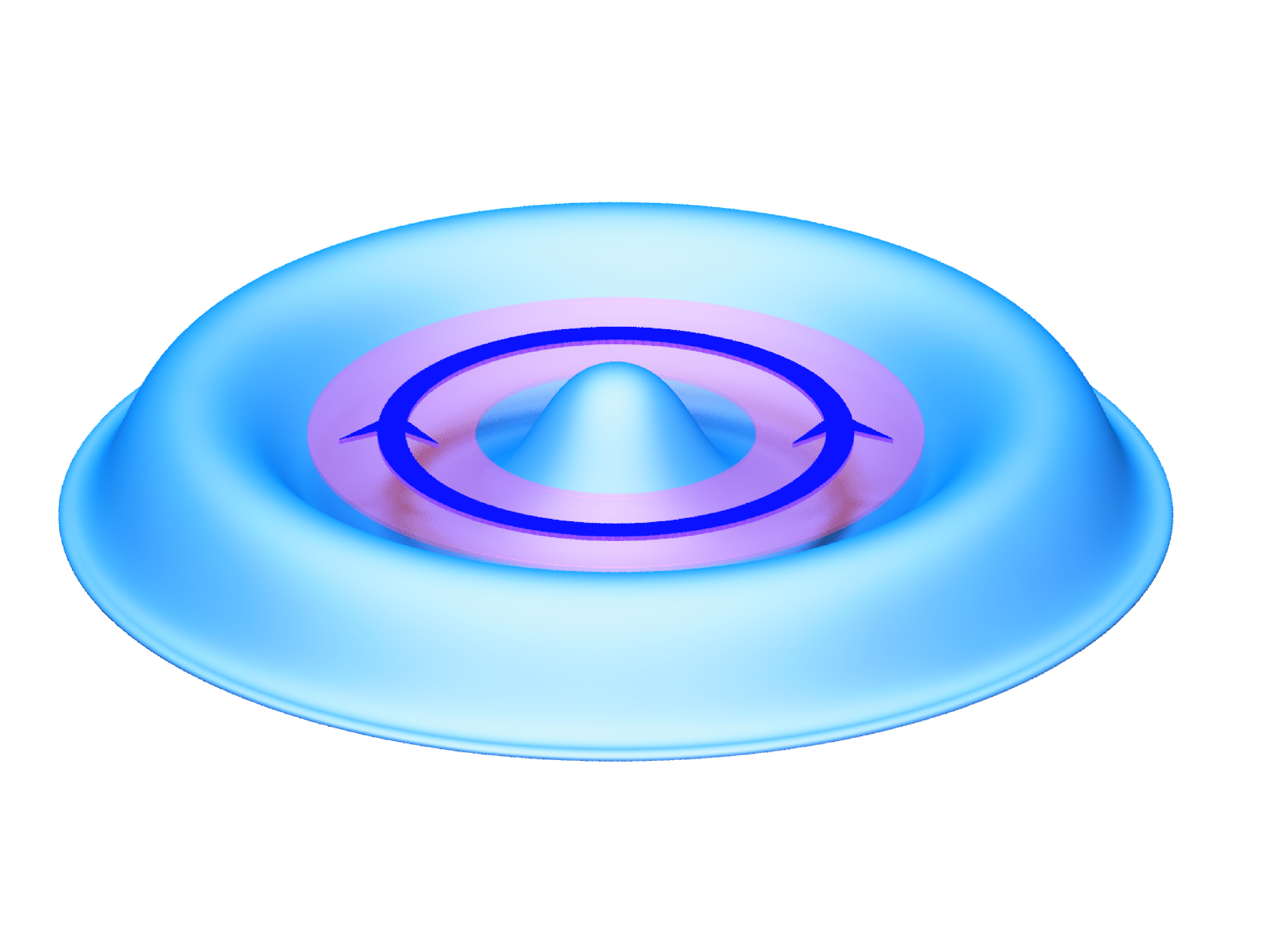
In an article published in Science Advances [1], Prof. Pavlos Savvidis (Westlake University & IESL's Visiting Researcher), Dr David Petrosyan (Research Director) and their younger colleagues and collaborators report on the experimental realization and characterization of a novel platform for analog quantum computation with semiconductor exciton-polaritons. In this system, a condensate of polaritons is confined by a spatially-patterned pump laser in an annular trap that supports energy-degenerate counter-circulating vortex modes with laser-controlled coupling. The qubit states are formed by the symmetric and antisymmetric superpositions of the vortex modes. By engineering the potential, coherent dynamics of the qubit and its initialization in the desired state can be performed with high precision. The authors also discuss potential avenues to realize controllable interactions between such qubits to implement quantum gates and algorithms analogous to quantum computation with standard qubits.
[1] Barrat et al., Sci. Adv. 10, eado4042 (2024) https://doi.org/10.1126/sciadv.ado4042