
Position Description
Θεωρητική μελέτη αλληλεπίδρασης ακτινοβολίας Λέιζερ με Νανοσωματίδια
Required Qualifications
- Διδακτορικό δίπλωμα στην Φυσική
- Εμπειρία στην θεωρητική μελέτη αλληλεπίδρασης ύλης-ακτινοβολίας
- Δημοσιεύσεις σχετικές με το αντικείμενο της θέσης
- Άριστη γνώση της Αγγλικής γλώσσας
Application Procedure
Οι ενδιαφερόμενοι καλούνται να υποβάλουν τις αιτήσεις τους και όλα τα απαραίτητα δικαιολογητικά, ηλεκτρονικά στη διεύθυνση hr@iesl.forth.gr με κοινοποίηση (cc): στον Δρ Εμμ. Στρατάκη (stratak@iesl.forth.gr).
Οι αιτήσεις θα πρέπει να αποσταλούν με την ένδειξη: «Αίτηση στο πλαίσιο της πρόσκλησης εκδήλωσης ενδιαφέροντος με Α.Π. … και κωδικό θέσης … » (όπως αυτός αναφέρεται στον Πίνακα του Παραρτήματος). Αντικατάσταση της πρότασης ή διόρθωση αυτής ή συμπλήρωση τυχόν ελλειπόντων δικαιολογητικών επιτρέπεται μόνο μέχρι τη λήξη της προθεσμίας υποβολής των προτάσεων.
Appointment Duration
6 μήνεςPosition Description
Required Qualifications
The required qualifications are graduate university degree in physics or related disciplines, and good command of the English language. Good theoretical background in quantum theory, as well as computer and programming skills, are desired.
Application Procedure
Interested candidates are encouraged to contact
Dr. David Petrosyan, email: dap@iesl.forth.gr tel: +30 2810 391131
Dr. Georgios Nikolopoulos, email: nikolg@iesl.forth.gr tel: +30 2810 391005
Appointment Duration
36 months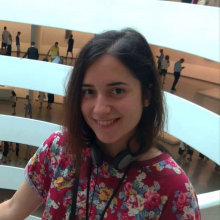
Evi Aspropotamiti joined our group as a diploma student, and she worked on quantum state discrimination, and some applications in a twin-field quantum key distribution protocol. In March 2020, she moved to the group of Prof. D. Psaltis, at EPFL in Lausanne, for post-graduate research.
Education
- 2020: B.Sc. in Physics, Department of Physics, University of Crete, Greece
Career
- 2020: Post-graduate research, EPFL, Lausanne, Switzerland
Interests
- Quantum Cryptography
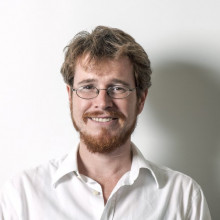
Dr. Lukas F. Buchmann received his PhD degree in Physics from the University of Crete in 2010, having spent 3 years in our Group.
He then worked as a postdoctoral researcher at the University of Arizona (USA) and at the University of California, Berkeley (USA).
Between 2015 and 2017 Lukas was a joint research associate at Aarhus University (Denmark) and in our group. After staying
two more years at Aarhus University, Lukas went to Switzerland in 2019, where he is now a Senior Expert in Software and Optical
Measurements at FISBA AG.
Education
- 2010: PhD in Physics, Department of Physics, University of Crete, Greece
- 2007: M.Sc. in Elementary Particle Theory, University of Durham, Durham, England
- 2006: B.Sc. in Physics, University of Zurich, Zurich, Switzerland
Career
- 2015-2019 Research Associate, Aarhus University, Denmark
- 2013-2015 UC Berkeley, Berkeley, CA, Post-Doctoral Researcher
- 2010-2013 Post-Doctoral Researcher, University of Arizona, Tucson, AZ
Interests
- Quantum Technology & Metrology
- Quantum Optics
- Quantum/Classical Transition
- Nonlinear Phenomena
Awards/Prizes/Distinctions
- 2013-2015: SNSF Fellow
Why is it difficult to make small, sub-wavelength in size, lasers? Nowadays we have access to powerful lasers, built to serve many purposes, but what if we wanted to have miniaturized versions of them? To do so we would need to consider materials and techniques other than the traditional; even so, as we start reducing the size of the laser, eventually we will have to encounter a trade-off between the system dimensions and the quality of the laser.
Recently, our group proposed a design that overcomes this apparent dead end [1-3]. The concept is based on using dark resonant states in low-loss dielectrics as an equivalent of the laser cavity, that is, a dark state essentially replaces the mirrors used in big lasers. This is possible because dark states are localized, resonant electromagnetic modes that do not radiate. Therefore they are used to separate the gain-coupled resonant photonic state responsible for macroscopic stimulated emission from the coupling to free-space propagating modes, allowing independent adjustment of the lasing state and its coherent radiation output.
In this talk, I will give a detailed discussion of the key-functionalities and benefits of this design, such as radiation tunability, directionality, sub-wavelength integration, and simple layer-by-layer fabrication.
References
[1] Droulias, S., Jain, A., Koschny, T. & Soukoulis, C. M. Novel lasers based on resonant dark states. Phys. Rev. Lett. 118, 073901 (2017).
[2] Droulias, S., Jain, A., Koschny, T. & Soukoulis, C. M. Fundamentals of metasurface lasers based on resonant dark states. Phys. Rev. B 96, 155143 (2017).
[3] Droulias, S., Koschny, T. & Soukoulis, C. M. Finite-Size effects in metasurface lasers based on resonant dark states. ACS Photonics 5(9), 3788 (2018).
