

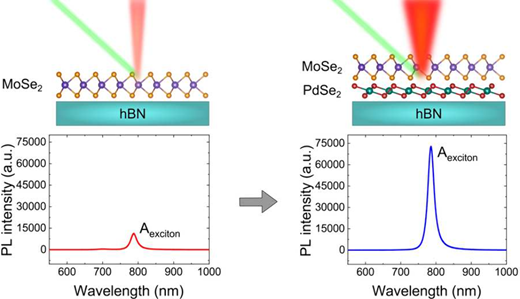
A new study published in Nano Letters highlights the strong international character of collaborative research in the field of two-dimensional materials and van der Waals heterostructures. The work brings together researchers from several leading institutions across Europe and Japan, including the Institute of Electronic Structure and Laser (IESL) of the Foundation for Research and Technology–Hellas (FORTH), with significant contributions from Danae Katrisioti and Ioannis Paradisanos, as well as Ca’ Foscari University of Venice (Italy), Friedrich Schiller University Jena (Germany), Politecnico di Milano (Italy), the National Institute for Materials Science (NIMS, Japan), and the University of Chemistry and Technology (Czech Republic).
In this study, the researchers demonstrate that stacking monolayer MoSe2 with PdSe2 into a type-I van der Waals heterostructure produces an unusually large enhancement of the A-exciton efficiency, alongside strong quenching of the B-exciton at room temperature. These findings establish that interlayer coupling can be a powerful, straightforward knob for tuning light emission in 2D semiconductors, with promising implications for optoelectronic applications where efficient, controllable emission matters.
Reference: Rozhin, P., Contin, E., Katrisioti, D., Weickhardt, T., Ramzan, M. S., Bertolotti, M., ... & De Fazio, D. (2026). Highly Efficient Exciton Modulation in MoSe2/PdSe2 Heterostructures. arXiv preprint arXiv:2605.13211. doi:https://doi.org/10.1021/acs.nanolett.6c02581
