

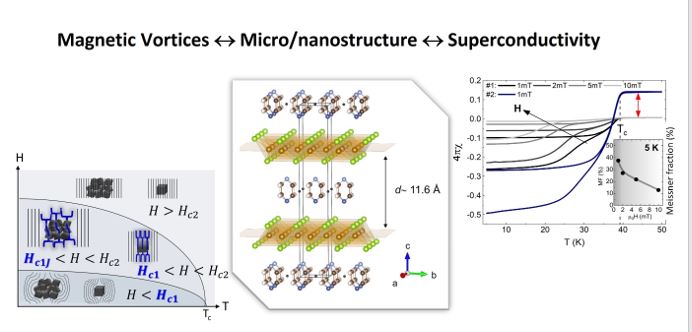
Collaborative research by FORTH’s QMM Lab reveals that organic-molecule-intercalated iron superconductors — despite reaching a high Tc of 39 K — struggle to carry high current.
Superconductors carry electricity with zero resistance and underpin technologies from MRI scanners to fusion reactors. Yet what determines their real-world usefulness isn't only how cold they must be — it's how much current they can sustain, known as the critical current density (Jc).
In a new study published in Superconductor Science and Technology, Myrsini Kaitatzi and Alexandros Lappas (IESL-FORTH & University of Crete) probe this trade-off in an iron selenide (FeSe) superconductor whose transition temperature (Tc) is raised from 8 K to nearly 39 K by intercalating lithium and pyridine molecules between its atomically thin 2D layers. This structural modification expands the interlayer spacing and enhances superconductivity — but the soft-chemistry synthesis route required to achieve it also yields a polycrystalline material with an inherently complex micro/nanostructure.
Using contact-free trapped-flux magnetization measurements, the team compared a single-phase powder with a densified pellet. Both showed Jc values (~103 A cm-2) roughly an order of magnitude below single-crystal FeSe, driven primarily by weak intergranular coupling that lets magnetic vortices penetrate too readily across grain boundaries. Residual impurity phases further degraded performance in the pellet, despite improved grain-to-grain contact upon pelletization.
The results sharpen a broader materials-science challenge: unlocking the high transition temperatures offered by molecular intercalation demands equal attention to disorder and microstructural control — grain connectivity, phase purity, and densification — if these quantum materials are to progress from laboratory curiosities toward viable high-field superconducting wires.
Citation: M. Kaitatzi & A. Lappas, Supercond. Sci. Technol. 39 065014 (2026).
