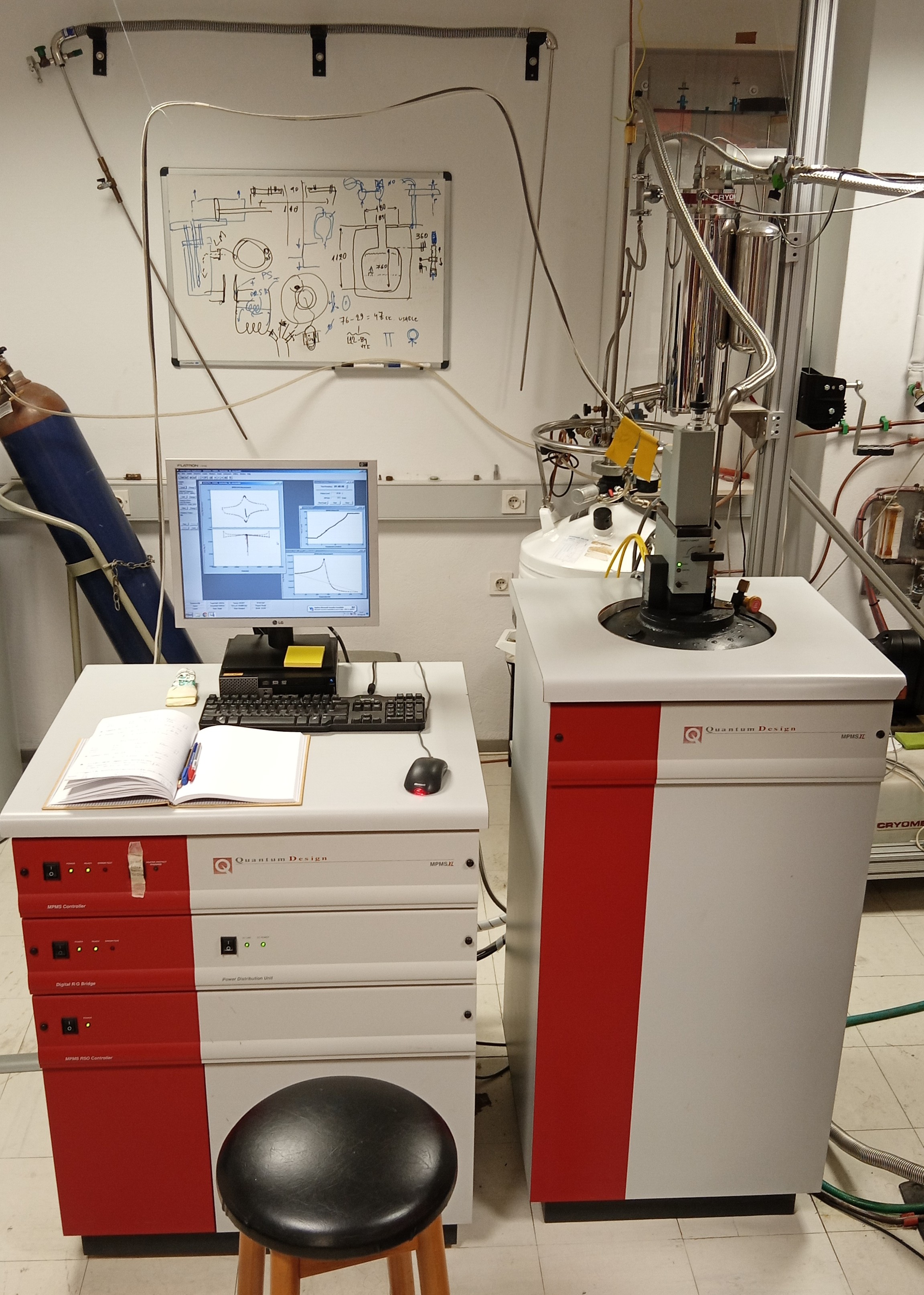
A Superconducting Quantum Interference Device (SQUID) provides exceptional sensitivity for probing static and dynamic cooperative electronic phenomena —including interactions among charge carriers and magnetic or electric moments— as well as phase transitions in correlated electron systems, in both bulk and nanoscale materials.
Applications:
SQUID magnetometry provides invaluable insight into the physicochemical response of quantum materials by measuring the magnetic moment as a function of applied magnetic field (e.g., magnetic hysteresis loops) or temperature. These measurements enable detailed characterization of magnetic, superconducting, magnetoelectric, and other correlated electronic states over a broad temperature range. Owing to its exceptional sensitivity, reliable measurements can be performed using samples weighing only a few milligrams. Beyond hysteresis measurements, SQUID magnetometry enables precise determination of key superconducting properties, including the critical temperature, Meissner effect, critical fields, and critical current density. It also provides quantitative characterization of magnetic phase transitions, such as the Curie, Néel, blocking, and spin-freezing temperatures, thereby revealing the behavior of ferro-, ferri-, antiferromagnetic, superparamagnetic, and spin-glass systems. These capabilities are essential for applications ranging from magnetic recording and spintronic devices to biomedical technologies, including MRI-guided therapeutics.
Specifications:
SQUID magnetometer (Quantum Design MPMS XL-7): measures the total magnetic moment of a sample as a function of temperature, magnetic field, time. The sample is moved through a set or pick-up coils (in second derivative geometry) in a continuous (DC) or oscillatory (RSO; relative sensitivity possible is 10-8 emu) motion. The system offers a maximum field up to 7 Tesla and ultra-low field (<0.05 Gauss) capability to explore the static (DC) and dynamic (AC) magnetic properties of samples in various forms, including nanoparticles, thin films, bulk single crystals, and even samples in liquid media (e.g., ferrofluids), over extended areas of temperature (Low-T: 1.9 - 400 K and High-T: 300 - 800 K) and dynamic range (f= 0.01 – 1000 Hz). In addition, a fiber optic sample holder allows studying magnetization of a sample under the influence of a light source. Typical container, gelatin capsule ~15 mm long, with O.D. ~5 mm. The software measurement sequencer provides a set of high-level actions to enable you to write and control measurements automatically and in a way that suits your own specific requirements.
Access Routes: