

Metasurfaces are ultra-thin man-made materials made of periodically arranged subwavelength building blocks. They hold the promise of revolutionizing the interaction of electromagnetic radiation with matter, by offering novel properties unattainable with natural materials (anomalous refraction, near-zero permittivity, artificial magnetism), enabled by the resonant nature of their building blocks. At the same time, they are extremely thin with respect to the wavelength and amenable to standard planar manufacturing techniques.
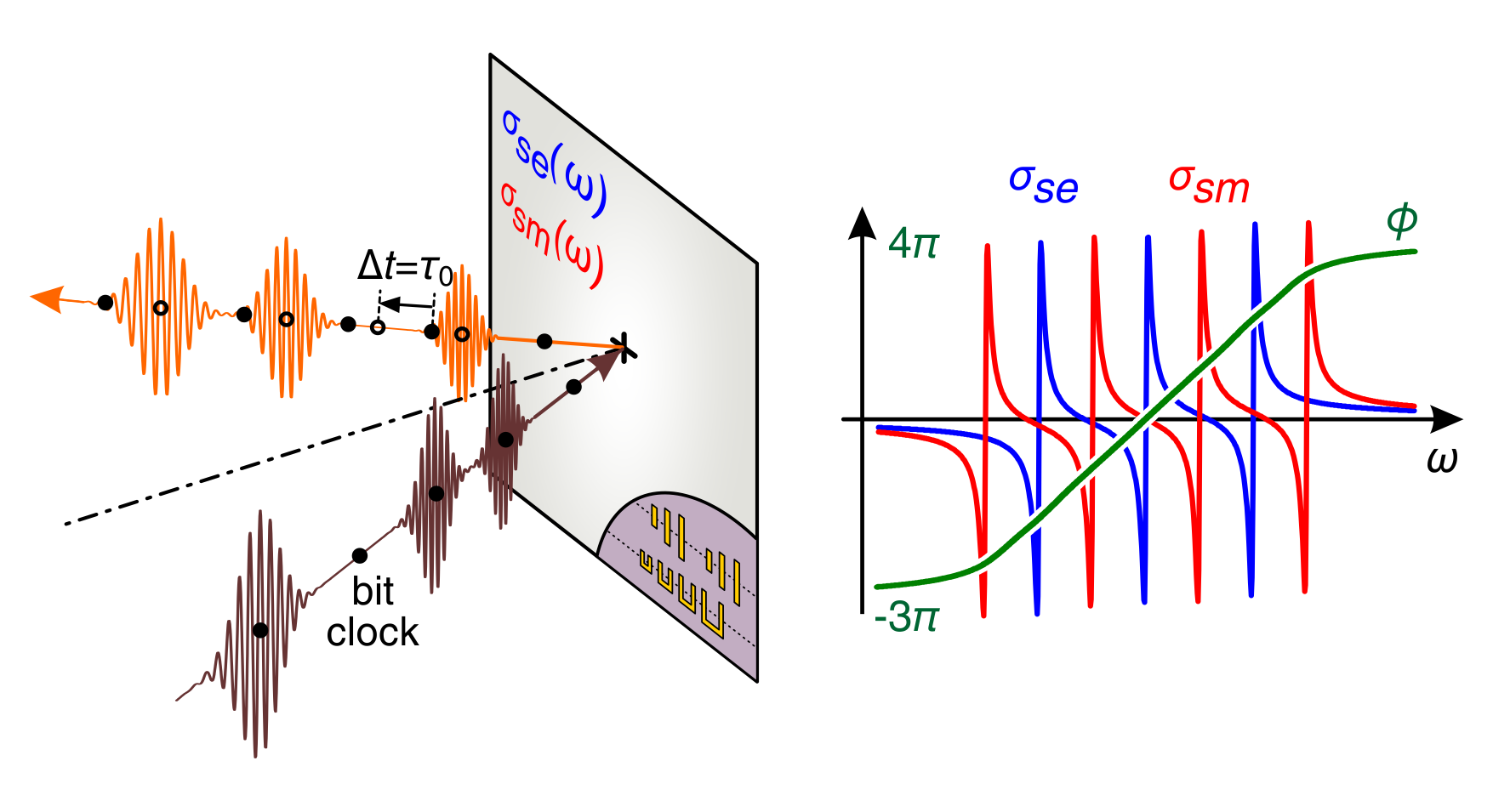
However, there are specific physical limitations that restrict the potential of metasurfaces: (i) their response is typically narrowband and (ii) the phase delay that can be imparted on the incident wave is limited (less than 2π). PHOTOSURF aims to break free from these longstanding limitations by proposing broadband multiresonant metasurfaces that combine the advantages of strong resonant response (phase delay, energy storage, field enhancement) with an arbitrarily-broad spectral bandwidth controlled by the number of resonances. This is achieved by implementing a very specific combination of multiple electric and magnetic resonances which arise from meta-atoms properly arranged in the unit cell.
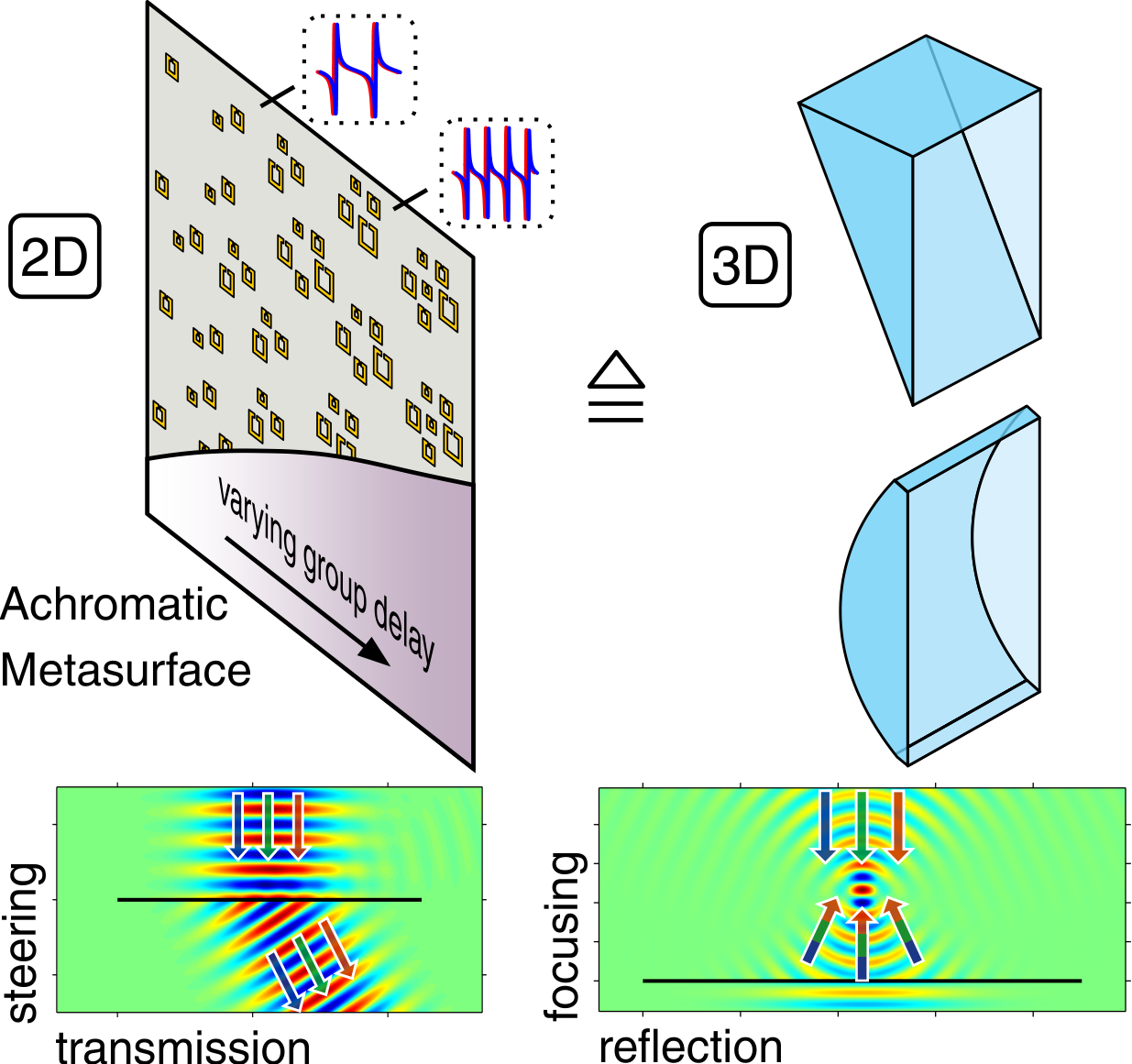
Having the broadband response as a common baseline, PHOTOSURF will address in a unified approach different physical problems, targeting the control of different aspects of the electromagnetic wave (temporal and spatial wavepacket profile, polarization, frequency). The broader scope of PHOTOSURF is to replace conventional dispersive, diffractive, polarization-converting, and nonlinear bulk components with ultra-thin counterparts, offering significant technological advantages (size, weight, fabrication, integration). The envisioned breakthroughs will open metasurfaces to real-world photonic applications, where signals are rarely narrowband (monochromatic).
The objective of PHOTOSURF is to propose novel functional metasurfaces with broadband operation, while at the same time exploiting the advantages of strongly resonant response. As metasurfaces are typically narrowband, this breakthrough will be enabled by implementing multiple resonances within a metasurface unit cell. Opening metasurfaces to broadband applications while retaining a resonantly-enhanced response constitutes the main novelty of PHOTOSURF. This extension is of utmost importance since in real-word photonic applications signals are rarely narrowband (monochromatic). Within PHOTOSURF the concept of broadband response through specifically-designed multiple resonances will be transferred and applied to different physical phenomena leading to a novel ultrathin and broadband optical components for:
- Achromatic pulse delay and compression
- Achromatic wavefront manipulation
- Polarization and amplitude control
- Frequency generation exploiting nonlinearity
Principal Investigator

External Personnel


Funding


Alexia is an Electronic and Computer Engineer working on Power amplifier and integrated RF design. She has worked in numerous projects involving MOSFET modelling, radiation hard environment design, analog ring oscillators and other RF IC.
Education
- 2021, M.Sc in Microelectornics, Electrical and Computer Engineering, Technical University of Crete, Greece
- 2016, B.Sc in Electronic and Computer Engineering, Technical University of Crete, Greece
Career
- 12/2019 - 04/2020, R&D privately funded Project Scholar, Electrical and Computer Engineering, Technical University of Crete, Greece
- 12/2017 - 12/2019, R&D EU project scholar, Electrical and Computer Engineering, Technical University of Crete, Greece
- 12/2016 - 03/2017, R&D privately funded Scholar, Electrical and Computer Engineering, Technical University of Crete, Greece
Interests
- RF / Analog CMOS design
- Integrated circuits
- Amplifier and oscillators
Position Description
Myltiphoton imaging.
For the full announcement, follow the link "Related Documents"
Required Qualifications
- PhD degree in science or engineering
- Proven experience in lasers
- At least two years of experience in the position topic
- Scientific publications relevant to the topic in international scientific journals
- Excellent knowledge of the English language
Application Procedure
Interested candidates who meet the aforementioned requirements are kindly asked to submit their applications to the address (hr@iesl.forth.gr), with cc to the Scientific Coordinator Dr Maria Farsari (mfarsari@iesl.forth.gr).
In order to be considered, the application must include:
- Application Form (Form Greek or Form English to the left)
- Brief CV
- Scanned copies of academic titles
Appointment Duration
6 monthsPosition Description
Ανάπτυξη νανοπρόσθετων υλικών πχ οξειδίων μετάλλων με τεχνικές φιλικές προς το περιβάλλον, ο βασικός χαρακτηρισμός τους και η μελέτη της αναμειξιμότητάς τους σε πολυμερικές μήτρες όπως του HDPE. Επιπλέον, θα κατασκευαστούν πολυμερικά νανοσύνθετα νήματα διαμέτρου 1.75mm για χρήση σε τρισδιάστατους εκτυπωτές, θα εκτυπωθούν δείγματα τρισδιάστατης γεωμετρίας και θα μελετηθεί η αντιρρυπαντική και φωτοκαταλυτική τους συμπεριφορά. (ΠΕ 2 και ΠΕ4)
Για το πλήρες κείμενο της πρόσκλησης ακολουθήστε τον σύνδεσμο 'Related Documents'
Required Qualifications
- Πτυχίο Φυσικής, Χημείας, ή Επιστήμης Υλικών
- Μεταπτυχιακός τίτλος σπουδών τμ. Φυσικής, Χημείας ή Επιστήμης Υλικών
- Διδακτορικό δίπλωμα ειδίκευσης τμ. Φυσικής, Χημείας ή Επιστήμης Υλικών
- Ερευνητική εμπειρία σε σύνθεση και χαρακτηρισμό πολυμερικών νανοσύνθετων δειγμάτων με τεχνικές τρισδιάστατης εκτύπωσης
Desirable Qualifications
- Επιστημονικές δημοσιεύσεις σε διεθνή περιοδικά με κριτές, σχετικές με τη σύνθεση και το χαρακτηρισμό πολυμερικών νανοσύνθετων δειγμάτων με τεχνικές τρισδιάστατης εκτύπωσης
- Επιστημονικές δημοσιεύσεις σχετικές με νανοδομημένα υλικά με φωτοκαταλυτική/αντιρρυπαντική δράση
Application Procedure
Στο φάκελο υποβολής της πρότασης θα πρέπει να εμπεριέχονται τα ακόλουθα:
- Αίτηση (form Greek στην αριστερή στήλη) με αναφορά στον κωδικό της θέσης
- Αναλυτικό Βιογραφικό Σημείωμα
- Ευκρινές φωτοαντίγραφα τίτλων σπουδών
ΥΠΟΒΟΛΗ ΠΡΟΤΑΣΕΩΝ
Οι ενδιαφερόμενοι καλούνται να υποβάλουν τις αιτήσεις τους και όλα τα απαραίτητα δικαιολογητικά, ηλεκτρονικά στη διεύθυνση hr@iesl.forth.gr με κοινοποίηση (cc): στον Δρ Γ. Κενανάκη (gkenanak@iesl.forth.gr). Οι αιτήσεις θα πρέπει να αποσταλούν με την ένδειξη: «Αίτηση στο πλαίσιο του προγράμματος «Καινοτόμα υλικά για δίκτυα ιχθυοκαλλιέργειας με περιβαλλοντικά φιλική αντιρρυπαντική δράση», της πρόσκλησης εκδήλωσης ενδιαφέροντος με Α.Π. … και κωδικό θέσης … » (όπως αυτός αναφέρεται στον Πίνακα του Παραρτήματος).
