

In 2025, the Journal of Physics B: Atomic, Molecular and Optical Physics (IOP Publishing) highlighted a selection of outstanding works that shaped atomic and molecular physics during the year. Among these was a review article led by researchers from the Foundation for Research and Technology-Hellas (FORTH), Institute of Electronic Structure and Laser (IESL), underscoring the institute’s leading role in research on strong-field and quantum light–matter interactions.
The article, entitled “Recent developments in the generation of non-classical and entangled light states using intense laser–matter interactions” was authored by Th. Lamprou, N. Tsatrafyllis, and P. Tzallas from IESL-FORTH, in collaboration with P. Stammer, J. Rivera-Dean, and M. Lewenstein from ICFO (Spain), as well as M. F. Ciappina from the Guangdong Technion—Israel Institute of Technology. Its inclusion in the 2025 highlights reflects both its scientific impact and the international visibility of research carried out at IESL-FORTH.
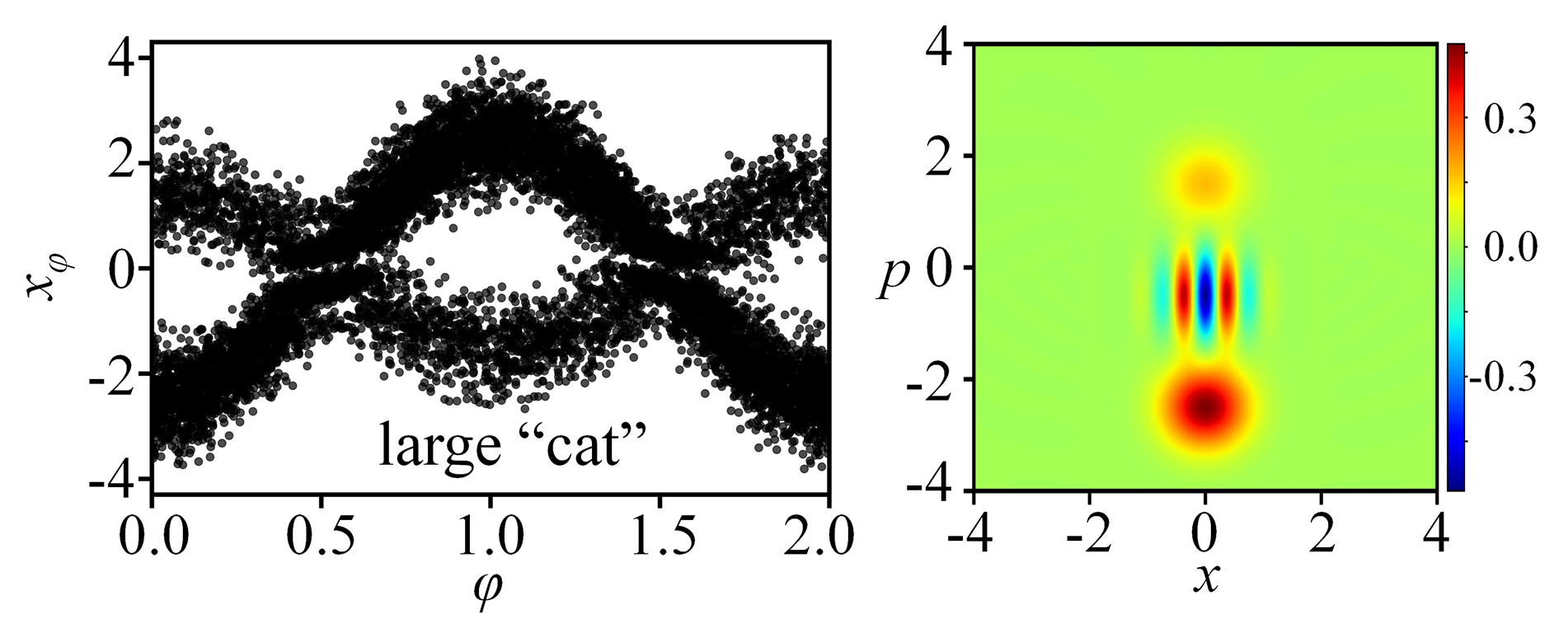
In this work, the researchers examined the fundamental importance of non-classical and entangled light states in quantum mechanics and their growing relevance for emerging quantum technologies. They emphasized the need for developing efficient methods to generate such states and reviewed recent evidence showing that intense laser–matter interactions can provide a powerful pathway toward this goal. In particular, they discussed how fully quantized theoretical approaches, combined with the process of high-harmonic generation, enable the production of high-photon-number non-classical and entangled light spanning frequencies from the far-infrared to the extreme-ultraviolet. The authors outlined the core operational principles behind these approaches and analyzed recent progress, as well as future perspectives, in non-classical light engineering using strong optical fields. They further highlighted the potential applications of these advances in ultrafast science and quantum information, concluding that these developments mark an important step toward novel quantum nonlinear spectroscopy techniques based on the interplay between the quantum properties of light and quantum matter.
Reference
Lamprou, T., Stammer, P., Rivera-Dean, J., Tsatrafyllis, N., Ciappina, M. F., Lewenstein, M., & Tzallas, P. (2025). Recent developments in the generation of non–classical and entangled light states using intense laser–matter interactions. Journal of Physics B: Atomic, Molecular and Optical Physics. 58(13), 132001. Doi: 10.1088/1361-6455/add9fe
