
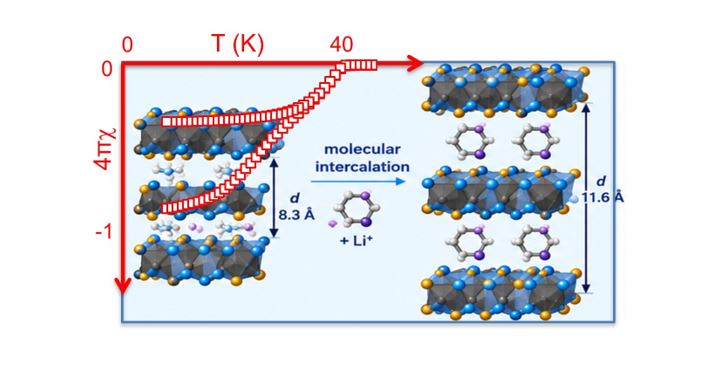
Latest work from FORTH’s QMM [1] Lab explores a fundamental question in condensed matter physics: what drives superconductivity—enabling materials to carry electricity without resistance—and, in particular, what controls its emergence at relatively high temperatures in iron-based materials? The study shows that simply increasing the separation between their conducting layers is not sufficient; instead, molecular insertion modifies how electrons are transferred and distributed within these quantum materials, providing a route to tuning superconductivity.
Revealing these microscopic changes was made possible by the unique brightness and sensitivity of synchrotron X-rays, combining high-resolution X-ray diffraction with synchrotron Mössbauer spectroscopy to probe both the material’s atomic-scale structure and the local electronic environment of iron. Led by Dr. Alexandros Lappas [2] the research brings together expertise from the IESL- Foundation for Research and Technology–Hellas (FORTH) and the Department of Materials Science and Engineering at University of Crete in Greece, together with the European Synchrotron Radiation Facility (ESRF) in France. The study was driven by PhD candidate Myrsini Kaitatzi [3], first author of the resulting publication. The findings provide important experimental evidence that microscopic electronic structure—not structural expansion alone—is central to understanding and ultimately controlling unconventional superconductivity.
Citation: M. Kaitatzi, D. Bessas, S. Yaroslavtsev, D.C. Stoian, and A. Lappas, J. Phys. Chem. Solids 220, 114128 (2027).