
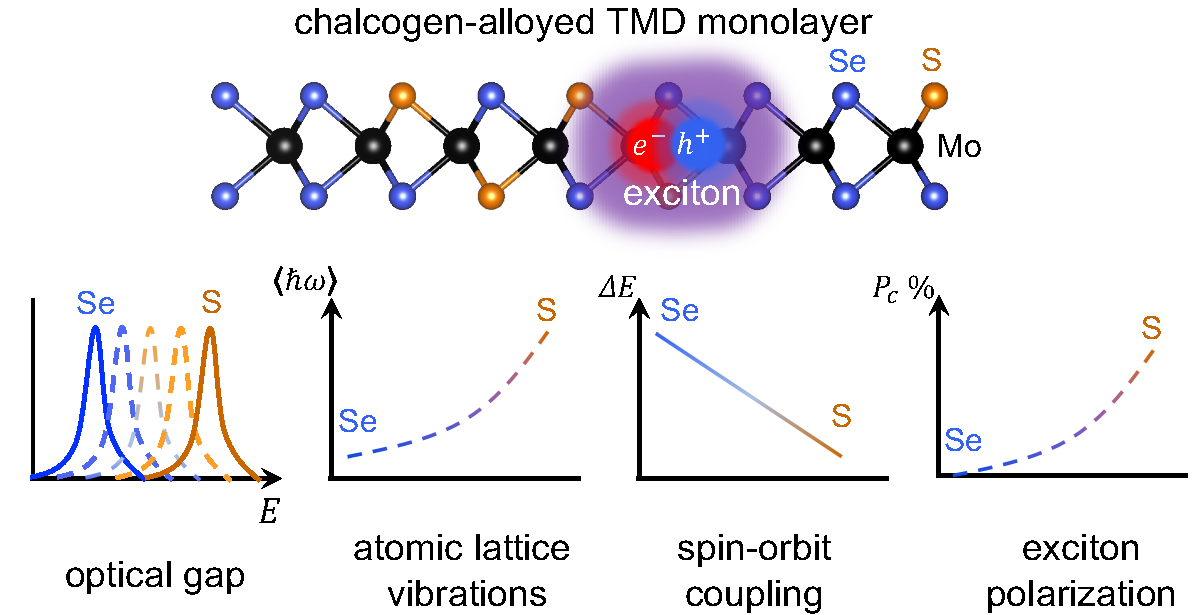
A new study entitled “Alloy Engineering of Excitonic Properties in TMD Monolayers” has been published in Physical Review Materials and selected as an Editor's Suggestion, highlighting the scientific significance and interest of the work.
The study is the result of an international research collaboration led by the Institute of Electronic Structure and Laser (IESL) of the Foundation for Research and Technology – Hellas (FORTH), Greece, in collaboration with INSA/CNRS (France), the National Institute for Materials Science (NIMS, Japan), the University of Chemistry and Technology Prague (Czech Republic), and the Beijing Institute of Technology (China).
Changing the atomic composition of a semiconductor offers a powerful way to tailor its properties. This study explores atomically thin alloys of molybdenum, sulfur, and selenium by probing their excitons, Coulomb-bound electron-hole pairs. By gradually replacing selenium with sulfur, the study reveals how alloying modifies exciton emission energies, atomic lattice vibrations, spin-orbit coupling and polarization of emitted light. Combining complementary optical spectroscopy techniques with first-principles calculations, the work provides a comprehensive understanding of how alloy composition influences excitonic behavior and its connection to electronic, vibrational, and spin-valley properties.
Reference: Katsipoulaki, E., Smiri, A., Spiliotakis, P., Mourzidis, K., Katrisioti, D., Taniguchi, T., ... & Paradisanos, I. (2026). Alloy engineering of excitonic properties in TMD monolayers. Physical Review Materials, 10, 104010. doi: https://journals.aps.org/prmaterials/abstract/10.1103/m7kc-8q5v [1]