
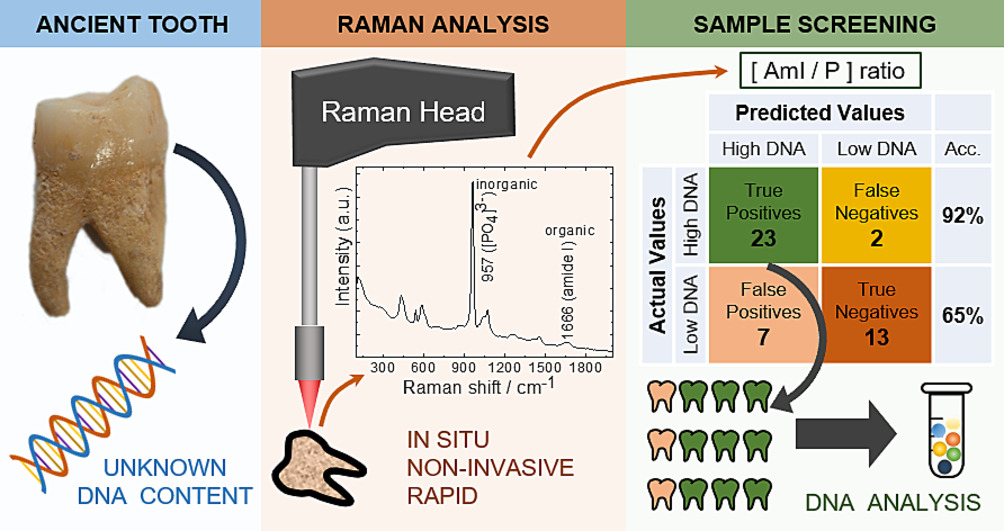
Supported through a Theodore Papazoglou FORTH Synergy Grant (Spectra-Gen: Spectroscopic Screening of Ancient Dental Remains for Optimized Archaeogenetic Analysis), researchers from IESL-Photonics for Heritage Science group [1], IMBB- Ancient DNA Lab [2], and ICS, studied a large number of ancient teeth, originating from various excavations and contexts in Greece and across a time span of 8 millennia.
In the context of this study, published recently in the Microchemical Journal, doi: org/10.1016/j.microc.2026.117446 [3], a straightforward and fast spectrochemical methodology, based on micro-Raman spectrometry, was developed and shown to serve as a suitable tool for screening teeth prior to genetic analysis, predicting which ones might exhibit a higher human DNA preservation.
As detailed in the article by A Philippidis et al, screening is achieved on the basis of a simple molecular index, the amide-to-phosphate ratio (Am-I/P), extracted from key vibrational bands in the Raman spectra, which serves as a proxy of the dental tissue protein content (typically collagen) relative to hydroxyapatite, namely the inorganic matrix. Analysis is performed, non-invasively, directly on intact teeth, by use of a compact, mobile micro-Raman spectrometer, focusing the laser probe on the cementum part, known to be protein rich. Ancient DNA analysis showed that teeth found to preserve endogenous human DNA, to a reasonable degree, showed indeed a good statistical correlation with the ones identified to be protein-rich based on the Am-I/P.