
The open access research paper entitled "Processing and Compositional Effects on the Stability of All-Inorganic Metal Halide Perovskite Anodes: A Comparative Study of Dry- vs. Slurry-Fabricated Electrodes," resulting from a collaboration between the Institute of Electronic Structure and Laser (IESL-FORTH), the Democritus University of Thrace (DUTH), and the University of Crete, has been published in the prestigious journal Advanced Materials Technologies (Wiley).
The study was led by Drs Konstantinos Brintakis and Athanasia Kostopoulou from the Ultrafast Laser Micro- and Nano-Processing (ULMNP) Group at IESL-FORTH, and Dr Georgios Zardalidis from the Micro & Nano Technology Lab at the Democritus University of Thrace.
This research addresses a critical gap in the development of next-generation energy storage materials, demonstrating that the stability of all-inorganic metal halide perovskite anodes is critically dependent on the electrode fabrication method—a factor often overlooked in the field. The team provides a comparative analysis of the structural and electrochemical performance of anodes fabricated via conventional slurry-casting versus solvent-free dry-processing, utilizing both lead-based (CsPbBr3) and lead-free (Cs2AgBiBr6) perovskites.
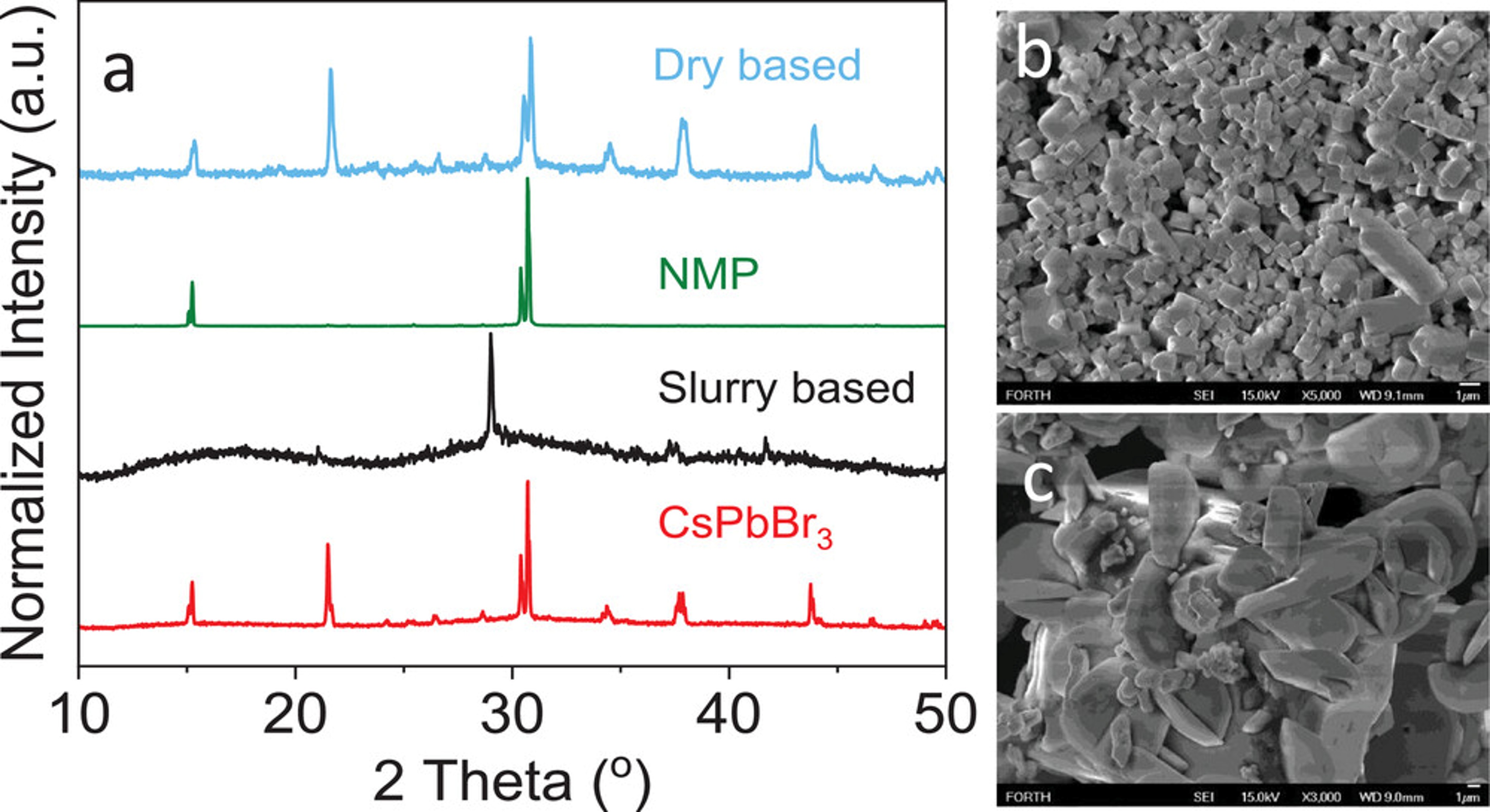
The researchers discovered that the conventional slurry process induces a catastrophic degradation of the CsPbBr3 structure into its constituent products before cycling even begins. In contrast, the dry-processing method successfully preserves the pristine crystalline phase of the material. Consequently, the dry-fabricated CsPbBr3 electrode exhibits excellent cycling stability driven by a reversible Li-Pb alloying mechanism, significantly outperforming the rapidly fading Cs2AgBiBr6 anode. These findings highlight that for this class of sensitive materials, optimizing the fabrication process to prevent chemical degradation is a primary and critical step toward achieving stable electrochemical performance.
Funding: The research project is implemented in the framework of the H.F.R.I call "Basic research Financing (Horizontal support of all Sciences)" under the National Recovery and Resilience Plan "Greece 2.0" funded by the European Union – NextGenerationEU (H.F.R.I. Project No. 16465).
Publication: K. Markopoulos, F. Bairamis, G. Zardalidis, et al. “Processing and Compositional Effects on the Stability of All-Inorganic Metal Halide Perovskite Anodes: A Comparative Study of Dry- vs. Slurry-Fabricated Electrodes.” Advanced Materials Technologies (2026): e02618. https://doi.org/10.1002/admt.202502618 [1]