Laser-assisted cleaning has become an essential tool in cultural heritage conservation, offering unmatched precision, control, and environmental compatibility. Yet, the complexity of surface deposits and the fragile condition of historic materials demand continuous monitoring to ensure safe and effective restoration.
At the Institute of Electronic Structure & Laser (IESL) – FORTH, researchers are addressing these challenges by developing next-generation methodologies that bridge high-end technology with the specific needs of cultural heritage preservation.
Building on this commitment to innovation, we are proud to announce the publication of the latest breakthrough study of the Photonics for Heritage Science group (https://www.iesl.forth.gr/en/research/photonics-heritage-science [1], https://phohs.iesl.forth.gr/ [2]) at IESL - FORTH: “Machine learning assisted real-time acoustic monitoring of laser cleaning in Heritage conservation,” published in npj Heritage Science, part of the Nature Partner Journals (npj) Series. Authored by Georgios D. Barmparis, Kristalia Melessanaki, G. P. Tsironis, George Tserevelakis, and Paraskevi Pouli, in collaboration with A.- N. Raikidis (undergraduate student) from the Department of Physics at the University of Crete, this work represents a major step toward data-driven, intelligent restoration technologies.
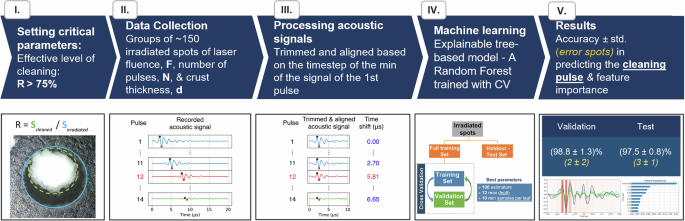
This study marks the beginning of a new era in laser cleaning for Heritage conservation — the first feasibility study demonstrating how real-time acoustic monitoring, combined with explainable machine learning models, can guide conservators in making informed decisions during laser cleaning. By analyzing the acoustic signatures generated during the laser–material interaction, the method can identify the exact laser pulse that fully removes unwanted layers without risking damage to the original artwork or substrate.
This research opens a new chapter in heritage conservation — where advanced AI meets the delicate art of preserving cultural treasures. It sets the foundation for smart, reliable, and safe laser cleaning protocols that support conservators in their mission to protect and restore our shared cultural heritage.
Read the full article here: https://rdcu.be/eS3QR [3]