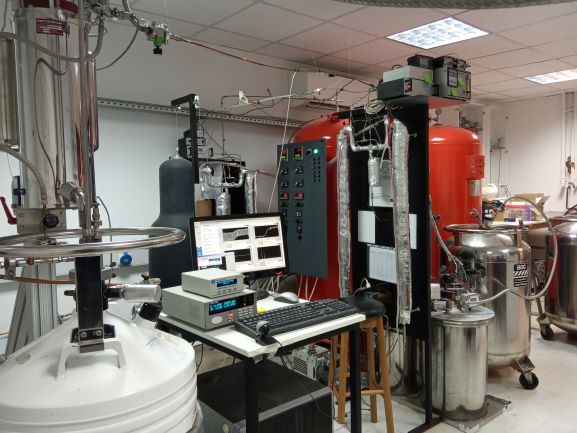
In everyday life generating and measuring temperature is straightforward, but in the quantum world, which reflects the behaviour of atoms, controlling the temperature is extremely more challenging. At very cold temperatures (cf. -269°C or near zero on the Kelvin temperature scale), as atoms are frozen, we can 'see' unique phenomena that would otherwise be masked by the thermal motion of atoms. As, complex materials are more likely to uncover their quantum properties at cold sample environments, low temperature refrigeration is an essential requirement.
Applications:
A tailored-made, small-scale home-built facility that supplies liquid helium (He) for our variable-temperature physical-property measurement systems. It enables temperatures of a few Kelvin (that is super cold with respect to ambient) through a pumped-helium system based on a digitally controlled pulse-tube cryorefrigerator. With this technology, warm He gas comes in contact with the Cold Head, where its thermal energy is absorbed into the 4 K (-269°C) heat exchanger. The process reduces the He-gas temperature, increasing its density, dropping it lower inside a condensing chamber; until it contacts the 4 K surface, where it condenses.The facility recycles the valuable He gas generated by boil-off from the liquid-He dewar of the SQUID magentometer and the magentoelectric workstation cryostat operating in our laboratory.
Specifications:
The CRYOMECH PT410 re-liquefier is designed to recondense helium boil-off from liquid-helium dewars and cryostats. Because boil-off rates vary with the type of temperature-dependent physical-property measurements being performed, we have developed a peripheral medium-pressure vessel assembly to store excess helium gas for subsequent use. Since the stored gas is susceptible to contamination by impurities such as O2 and N2, which can reduce re-liquefier efficiency, a custom-made, digitally controlled He-gas purification system has been developed. The system removes these impurities from the He-gas stream through chemical adsorption using combined beds of Cu-based adsorbent and cryogenically cooled molecular sieves. The facility thus enables recovery of the helium into the original dewar or cryostat, establishing a closed He loop with an average liquefaction rate of approximately 10 L/day.